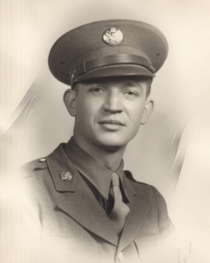
 Operation Chowhound/Manna Delft Commemorative Tile Bud, wearing his veteran’s hat, spoke to the staff on Memorial Day, as he always does. He reminded us of the sacrifices made by men and women in uniform. I listened with a heart still grieving the loss of my father. The first Memorial Day since his death. The first time in a long while that my siblings and I didn’t visit him and thank him for his service.
As a child, I hung his photo on the bedroom wall, Dad looking dashing in uniform, a rare photo of him with a mustache and pipe. I loved the one of him wearing a Scottish kilt taken while stationed in England. I loved them all. I loved my Dad.
He returned from the war a bit quieter than he had been. So I was told. He was a gentle spirit, responding to a need, but not a solider at heart. He was proudest of Operation Chowhound, or Manna, as our Cousins in the Netherlands called it. Near the end of the war, American and British airmen flew over the country devastated by the German army. Bridges had been bombed, fields flooded, canals mined. The Dutch people were starving.
I have heard the story from my father, from family in the Netherlands, and from a couple there who still live by the field where they watched bombers fly low, dropping not bombs, but boxes and tins of food: Operation Manna.
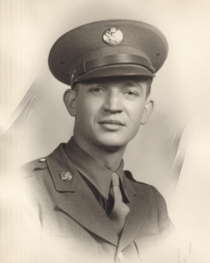 Dad served in the United States Eighth Army Air Force, 490th Bomb Group (H) as an intelligence officer and asked if he might go on one of the Chowhound flights. His Dutch father was one of sixteen children and Dad had lots of aunts, uncles, and cousins in Holland. He watched as boxes fell and people on the ground gratefully waved their thanks.
One Dutchman told me that German soldiers agreed to fire across the fields as food fell from the sky to discourage anyone from dashing out into the open spaces. The containers were heavy and could seriously injure or kill someone driven by hunger who might try to take some. The food was gathered and stored until it could be sent to those most in need.
I thought about my father, his family, and the food drop as Bud spoke to us before our workday began. In the midst of suffering, atrocities of war, and hatred, goodwill reigned for a few hours during the days between April 29 through May 5. Hostilities gave way to humanitarian response to suffering.
I think of Syria, of Afghanistan, of places on our earth ravaged by war where not only soldiers but civilians, children and adults also suffer the consequences today. I pray for Grace somehow to move hearts and minds, armies and politicians to make a way for humanitarian aide to again replace hostilities. I am sure in children’s bedrooms here and around the world, photos of fathers and mothers in uniform hang on the walls. All those young ones will not be as blessed as I was; all their parents will not return.

 On this feast of the Ascension, I offer the reflections of two Catholic’s on the subject, one a theologian and the other a specialist in the fields of spirituality and systematic theology. The first is Karl Rahner, a German Jesuit whose contributions including those at Vatican II have made him one of the most influential theologians of the twentieth century. In the book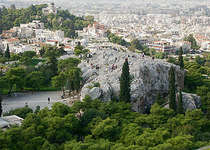
 PHOTO: Mary van Balen But now ask the beasts to teach you,/ the birds of the air to tell you;/Or speak to the earth to instruct you,/ and the fish of the sea to inform you./Which of these does not know/that the hand of God has done this? Job 12. 7-9 from Morning Prayer
 Then Paul stood up at the Areopagus and said: “You Athenians, I see that in every respect you are very religious. For as I walked around looking carefully at your shrines I even discovered an altar inscribed “To an Unknown God.” What therefore you unknowingly worship, I proclaim to you. The God who made the world and all that is in it, the Lord of heaven and earth, does not dwell in the sanctuaries made by human hands, nor is God served by human hands because God needs anything. Rather it is God who gives everyone life and breath and everything…though indeed God is not far from any of us. For ‘In him we live and move and have our being.’ Acts 17.22-25, 27b-28
 PHOTO: Mary van Balen The homily at Mass yesterday included a reference to the pelican and the stained glass window depicting a pelican feeding her young. I first encountered this image in an old university building housing the school of theology. Intrigued by the old ceramic tile with the image of a pelican and her young, I made a rubbing of it in my journal and later asked about it.
 Supermoon, May 5, 2012 I wish I had a photo of the campfire, of someone holding up jumbo marshmallows flaming on the end of a stick looking like a torch, or another women eating the gooey treats like a drumstick. Or a photo of a woman sitting by the pond casting and catching fish into the night. Or of the supermoon edging the dark rain clouds with silver and then emerging glorious and bright.

 Could it be that the faithful might have a theological intuition that diverges from the Churchs teaching and that they might be right? It wouldnt be the first time. Blessed John Henry Newman thought so. He had studied the history of the Arians and used some of that history in his article, On Consulting the Faithful on Matters of Doctrine. Newman pointed out that the Arian heresy was defeated not by bishops or popes, most of whom supported the Arian position. The faithful, mostly the laity, were the ones who steadfastly held to the truth of the divinity of Jesus, sometimes at the cost of their lives. It was the consensus fidelium or consent of the faithful that saved the day.
 PHOTO: Mary van Balen One day last week and friend and I were walking through a small woods near my home.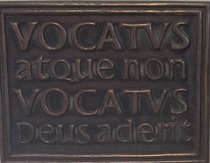
 Pierre Teilhard de Chardin May 1, 1881-April 10, 1955
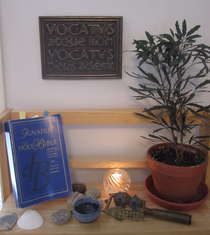
  This morning, the beginning of a day off work, I walked into my office, lit two candles while singing the old hymn, “Come Holy Ghost,” and sat facing the small collection of sacramentals surrounding the Bible. Having long neglected the practice of Lectio Divina and quiet prayer, I came again to, if nothing else, rest in the presence of God. The plaque above the bookcase reminded me that on the days I do not do this God is no less present to me. (Called or not called, God is present.)
 As Telihard says, we must “See or perish.” We must see Christ in one another. We must seek unity and solidarity, not division and discord. We must stand with those who are marginalized and remember that we move forward together or not at all.
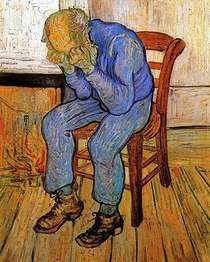
 “Sorrow” by Auguste Rodin 1881-1882 Reading
  Again the news surfaces during Holy Week, when Good Friday offers theGood Friday offers an opportunity for the Church to admit wrongdoing, repent, and ask for forgiveness, as all Christians are encouraged to do. Will this Good Friday pass as it did two years ago without church hierarchy taking advantage of it? I imagine so. Until it is grasped, and Church leadership is honest with itself and with the world, its credibility is lost and more faithful will find other communities to join for worship and Christian life.