Happy Thanksgiving to My Parachute Packers

Happy Thanksgiving to My Parachute Packers

PHOTO: Mary van Balen

PHOTO: Mary van Balen

The story Fr. Denis told during the homily today was simple but profound. Maybe you’ve heard it: A soldier was forced to eject from his plane during battle and float to earth with the help of his parachute. He landed safely but was captured and spent five years in a prisoner of war camp before finally returning home. Many years later, he was staying in a hotel and engaged in conversation with another older veteran. Turned out they both had served on the same aircraft carrier.

“I was a parachute packer,” the older man said. The two men talked for a while and then parted ways. Only after he had returned home and thought about the conversation did the pilot think, “That man may have packed my parachute. He may have been the one who saved my life.”

Likely, packing parachutes on an aircraft carrier during wartime was a long, tedious job. Doing the same thing over and over. Not glamorous. No medals to be had. Simply doing a job well. I wonder how many lives that man saved with his skill and attention to his task.

Then Fr. Denis wondered aloud about the parachute packers in our lives. Surely, there are many, and many of them strangers. People we will never know. The researchers who help develop drugs that save lives and treat depression or stave off infection. The factory workers who can the pumpkin that shows up on many tables today baked into a pie. Parents. Teachers. Friends. The kind associate who helps you find stuff when you’re in a hurry at the grocery store. People who raise the food you eat. Office workers who funnel all those insurance papers through the crazy systems that help make doctor’s visits or surgeries affordable.

The list, of course, is never ending. There is much to lament in our world. There always has been. But today is a day to focus on what is good, life-giving, and full of grace.

At the end of Mass, Fathers Denis and Dean and the two women altar servers handed out small loves of bread to everyone. A reminder of how we are fed, by God and by one another. We don’t make our way through life alone. We’ve got lots of parachute packers walking along with us. Some stay for the long haul. Some move in and out, maybe once and never again. Today we might take a minute or two to reflect on those who have “saved our lives” and give thanks for them and the God who made us all.

Happy Thanksgiving!

Tenderness and the Cross

Tenderness and the Cross

Saint John's University Arboretum  PHOTO: Mary van Balen

Saint John’s University Arboretum PHOTO: Mary van Balen

Originally published in The Catholic Times September 21, 2014

I have a friend who’s leaving to spend a year living and working in the L’Arche community in Trosly, a small town north of Paris, France, so I was particularly interested in the interview with L’Arche founder, Jean Vanier, in the recent issue of the National Catholic Reporter. (For those unfamiliar with L’Arche, it is an international organization that forms communities of people with mental disabilities and those who live and care for them.)

As I read the article, two words stood out. First was “community.” Vanier sees individualism as “the greatest evil of our time,” and says that people enter the world of individualism to show how good they are and often that they are better than the rest. It’s a proving ground.

Community, on the other hand, is “a school of love.” There we reveal our woundedness and needs as well as respond to the needs and woundedness of others. Community is transformational. It isn’t easy as any person

living in one can attest. Community isn’t always marriage, family, or religious life. It can be our parish or work community, extended family, a close circle of friends or coworkers for a common cause. Whatever form it takes, true community requires sacrifice as well as celebration.

The other word was “tenderness.” Vanier referred to a psychiatrist who, when asked for a sign of maturity, said “tenderness,” and understands tenderness, not non-violence, to be the opposite of violence.

While speaking of those with disabilities who come to L’Arche, Vanier noted the importance of helping them discover their preciousness and beauty, not so much by what is done, but by “being with.” Listening, treating them with respect, with tenderness, that is where transformation happens. “What is important,” Vanier says, “is relationships.”

Our world is broken, and all carry pain within. Many people expressed surprise after discovering Robin Williams had been battling deep depression for years. As Vanier suggested, those types of wounds are not shared in the world of individualism, but in community.

Some people’s struggles are more visible resulting from ignorance, fear, and oppression. The poor. Women. The LGBT community. People of color. Homeless people, many of whom suffer from mental illness. How do we respond to them with tenderness? My experience tells me that “being with” is what opens my heart to those I might otherwise see only as “other.”

Before reading this interview, I was working on a column reflecting on the mystery of last Sunday’s feast, the Exultation of the Cross. As I read about L’Arche, the two themes wove themselves together: The cross present in the living of community, and tenderness both leading to and flowing from embracing the cross.

Sunday’s mass collect put me off: “O God, who willed that your Only Begotten Son should undergo the Cross to save the human race…” I’ve never been able to get my head around the image of a God who would demand a bloody sacrifice, of a son, no less, to appease Divine justice. Unfortunately, that is often the approach taken to make sense of Jesus’ suffering and death. It just doesn’t fit with Jesus’ image of God as “Abba,” “Daddy.”

PHOTO: Mary van Balen

PHOTO: Mary van Balen

This intimate address to a parent exudes tenderness, not retribution. There’s the father who welcomes home the prodigal son, the mother hen who gathers and protects her chicks, the shepherd who looks for lost sheep.

Then there’s Jesus himself who tells his followers, “When you see me, you see the one who sent me.” Jesus ate with sinners, hung out with those on the fringes, embraced children, and preached giving oneself for others. When asked why he spent time with such people, Jesus replied, “Go and learn the meaning of the words ‘I desire mercy, not sacrifice.’”

Jesus spoke of God as community, Trinity and invited us to join in. As Vanier noted, community transforms. Community with God transforms completely.

No, I can’t imagine God willing Jesus to suffer. While I’m familiar with doctrines of substitutional, even penal atonement, I have to go with my prayer and my heart. The world couldn’t cope with the radical love and truth of Jesus, and rather than abandoning who he knew himself to be, Jesus embraced the cross his faithfulness brought. His death and resurrection poured the salve of unconditional love on the wounds of humanity, and calls us to do the same. Community. Tenderness. Jesus asks us to share in his cross and resurrection, opening the door to a transformative relationship with God and all God’s people.


© 2014 Mary van Balen

“Get Away” or “Get on Board”

“Get Away” or “Get on Board”

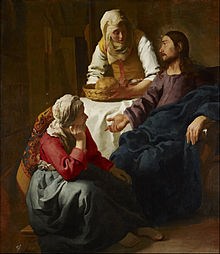
Christ in the House of Mary and Martha  by Jan Vermeer 1665

Christ in the House of Mary and Martha by Jan Vermeer 1665

As I listened to today’s Gospel reading, I pictured Jesus telling Peter to get out of the way, leave, calling him “Satan” to boot. Peter had protested Jesus’s statement of his impending suffering and death. It didn’t fit into Peter’s understanding of what Jesus was about and he didn’t hesitate to say so. Jesus knew what he was about and knew that living his life faithfully would enrage those in power. Suffering and death were in the cards. The only way to avoid it would be to be untrue to his call, and Jesus would have none of that.

In his homily, Fr. Denis put a different spin on Jesus’ response to Peter. Rather than telling Peter to “go away,” Jesus was admonishing him to “get on board.” “Get behind me” can mean “get with the game plan,” “support me.” I’d never thought of it that way, but it made sense. Why would Jesus want to banish the one he had just called “the rock,” the solid foundation of the church? He wouldn’t. He would, instead, point out the problem and encourage Peter to support him.

That’s heartening. Many times I’m sure my understandings or concerns get in the way of God’s work in and through me. What I think would be most productive may not be so. We just can’t see the whole picture. None of us can. A friend of mine in St. Louis pointed that out in her last email. While it may be convenient or seem best to paint the militarized police force as “bad guys,” it isn’t that simple. Dialogue, peace, and progress won’t happen until we banish that “Satan”  and engage one another in open conversation. Demonizing either side makes true reconciliation impossible. Yet, in the heat of the moment, many of us are inclined to see narrowly and act out of misconception.

Icon Mina and Jesus

Icon Mina and Jesus

Giving ourselves to Jesus’ mission of love and transformation of the world surely entails suffering for each of us. Life is hard. Loving is hard. Embracing our vocations, as they unfold throughout our lives, is made a bit easier with the support of friends and family. Their love doesn’t do away with the hard work, difficulties, and suffering we encounter, but it helps us “keep on keeping on” as Pete Seeger used to say.

Jesus spent time at the home of  Mary, Martha, and Lazarus. He enjoyed meals and walks and conversations with friends and disciples. Jesus didn’t want to boot Peter because he didn’t see the big picture. Jesus wanted him standing squarely behind him, supporting him even when what he did made no human sense.  Jesus wanted Peter to live like he believed the declaration he had made: You are the Messiah, the Son of God. Jesus wants us to live that way, too, trusting in the big picture we cannot see.

A Bad Hair Sunday

A Bad Hair Sunday

PHOTO:Mary van Balen

PHOTO:Mary van Balen

One look in the mirror told me I would not get away without washing and blow drying my hair. It is cut short for a few reasons. Besides liking how it looks, I also like being able to run a brush through it and head out to work, the grocery store, whatever. I thought I could do that on Sunday, so I dressed for work thinking I’d attend mass at St. Thomas, visit with friends, and then head to work. No so much.

Instead, I attended a church just a few minutes away. I would have time to return home and tame that head of hair. CPAP machine or Providence, not sure which did the job on my hair, but the service was filled with just what I needed to hear. I had written last week’s column on the OT reading and in the process had read through Mass readings for the week. Still, hearing the three readings proclaimed provides a fresh look, as does the homily.

The day began with feelings of frustration and discouragement: No news on the book, as usual. Working still selling stuff. My house was a mess. I hadn’t slept well. Generally, I was feeling a bit sorry for myself and unsure how to shake free of my “mood.”

Singing helps. One of the wonderful things about church on Sunday is singing. I used to sing all the time, guitar in hand, by myself or with others at sing-a-longs or other gatherings. Years ago, I had painted a sun and flower on my guitar case along with the words “How Can I Keep from Singing,”one of my favorites sung by Pete Seeger. So, belting out a few good songs feels good. Three singers including a piano player kept the tempo up and their harmonies were stirring. The words of the readings sunk deep into my heart: Elijah had to listen closely to hear a whisper…Jesus needed to take time to pray, by himself, in quiet…Peter did OK walking on water until he took his eyes of Jesus. Then he began to sink.

I need to pray in quiet times, not only as I go about my day at home and at work. While that prayer is also important, it’s different. Sometimes silence is what I need to listen, to hear. Taking one’s eyes off God is easy to do. Walking on water or making it through another day at work, it’s all the same. Lots of distractions. Lots of opportunities to focus on one’s self or what isn’t going as one hopes or what is. Jesus was about Love and service, and listening to the One who sent him into this world. It doesn’t sound difficult or at least not impossible. I suppose, at the moment, walking on water didn’t sound difficult to Peter either. It wasn’t as long as he walked in faith.

I was feeling better. I could take some quiet time before work. Eucharist was nourishing. As if all that were not enough, the closing song was none other than “How Can I Keep From Singing.” I couldn’t. Thinking of Pete Seeger and others who have walked this earth faithful witness to Love and service, I sang all the way home.


God Who Comes in Whispers

God Who Comes in Whispers

curly wind clip art.jpg

    First published in The Catholic Times, August 10, 2014, Volume 63:3

Sunday’s reading follows a dramatic showdown between Elijah and King Ahab after three long years of drought predicted by the prophet. During his reign, Ahab’s wife, Jezebel, spread the worship of Baal throughout the land and murdered the prophets of the Lord. Elijah alone remained. Prompted by God, Elijah met with the king and proposed they meet on Mount Carmel.

People from all over Israel were summoned including the prophets of Baal. Tired of their unwillingness to choose between the Lord and Baal, Elijah challenged them to watch and decide: The prophets of Baal were to prepare a sacrifice. Elijah would do the same. Each would call on their god to send fire to consume the offering.

You know the outcome. Despite a day of shouting, dancing, and self-mutilation, Baal’s prophets received no answer. Then Elijah, after preparing his sacrifice and inviting the people to douse it all with water three times, asked the Lord to answer his prayer so the people would turn their hearts again to the true God.

Fire consumed the sacrifice, the stones, the wood, and dried up all the water in the trench. Elijah commanded the people to slaughter all the prophets of Baal who were present. A small cloud over the sea grew larger and darker, and as God had promised, at last, rain came.

Jezebel was furious and vowed to take Elijah’s life. He fled until, exhausted, he sat down by a bush and asked God to take his life, but angels, not death, arrived. And they brought food. Twice they fed the old prophet. Strengthened, he traveled forty days to Mount Horeb.

This is where we meet Elijah in Sunday’s reading. After having spent his life striving to be faithful to his God, he wasn’t sure what he had accomplished. In spite of the spectacular results on Mount Carmel and the killing of Baal’s prophets, his world appeared unchanged.

A few lines are left out of Sunday’s reading. Between the night of sleep in the cave, and the command to stand on the mountain to wait for the Lord, Elijah hears God asking him what he is doing there.

He answers, “I have been very zealous for the Lord God Almighty. The Israelites have rejected your covenant, torn down your altars, and put your prophets to death with the sword. I am the only one left, and now they are trying to kill me too.”

Haven’t we felt that same way at one time or another? Having done our best, our best isn’t good enough. We’ve prayed, we’ve worked, and we’ve hoped but eventually, find hope elusive. As the angels observed, the journey is too much for us. For our resources. We need nourishment from God to go on, and even then we aren’t sure what to do next. Poverty, hatred, oppression, and disease continue to plague our world, and we have no answers.

Elijah waited to meet the Lord, but God didn’t come in the violence of wind or storms. He didn’t come in earthquakes or fire. The Lord didn’t come with force, but in a whisper. All the power of God. In a whisper.

I find that comforting. I think it’s because I can do “whispers.” I can do little things with great love. All the bombs raining down fire on people below haven’t brought peace. All the hatred and angry posturing haven’t brought needed change. Like Elijah’s showdown on Mount Carmel, they might look impressive, but in the end, they only make things worse.

We aren’t perfect. Elijah wasn’t either. He had four hundred and fifty prophets slaughtered because they believed in the wrong god. He wanted good. He wanted what God wanted, but couldn’t make it happen himself.

It’s a story repeated in scripture and in our lives. God brings good from our efforts in ways we don’t know. When we can see no path ahead, like Elijah, God invites us to trust. To be still. To listen. God is passing by. God is coming in whispers. Whispers from the lips of children, from a tired mother. From a scarred earth. From a cool breeze. From a kind deed. From some little thing you do that you think makes no difference.

The Holy One who made all that is and who is beyond our imaginings is a God who comes in whispers.

© 2014 Mary van Balen

Reentry

Reentry

PHOTO: Mary van Balen

PHOTO: Mary van Balen

Reentry is always a challenge whether one is returning to work or school from vacation, rejoining estranged groups of family or friends, adjusting to changing seasons, or for a select few, taking the bumpy ride back into earth’s atmosphere from a stint in outer space. When we “enter again” we are not the same people we were when we left. If they do what is intended, vacations change us into more relaxed and revitalized versions of ourselves. Engaging again with people who have caused us hurt or pain or whom we have hurt and avoided requires growth and maturity, an open heart and a bit of courage. I can’t imagine the change in perspective that affects those human beings who have had the privilege of seeing the earth from outer space. (A stunning book of photographs and reflections of astronauts from around the world give a glimpse into that experience: The Home Planet by Kevin W. Kelley ed. with a forward by Jacques-Yves Cousteau. I am not sure it is available to purchase, but you might find a used copy or one in a library.)

Wherever we are coming from and going to, retuning to life’s routines after a time away presents opportunities. Can I return to work without allowing the pace, atmosphere, and demands overwhelm me? If it’s a job I don’t like, can I keep a positive attitude and look for what is good in it? Am I able to let go of anger and the urge to see just one point of view, mine, when attempting to reconnect with those I’ve been avoiding?

I’m experiencing a reentry myself. After a ten day residency for a two-year spiritual guidance program, I’m doing laundry and preparing to return to work, writing, and family connections. It’s not easy. While the schedule was full of presentations, reflections, and hard work, it also provided a silent sabbath of retreat for a couple of days. The class had gathered from around the country and new and deep friendships were begun.

For ten days I didn’t have to prepare food or wash dishes. I could wander around the fifty-acre spiritual center in Maryland listening to birds and watching deer, foxes, and fireflies. On the night of the Perigee Moon (Super Moon) I found a comfortable place to sit and kept vigil with binoculars and a camera, fueled by a homemade chocolate chip cookie and cup of tea.

Part of the gift of the residency was the opportunity to cultivate a quiet, listening heart, sharing silence as well as conversation and presentations as a group. We focused on the Divine Presence in our lives and in the lives of those we serve. We held in prayer those dear to us, those hurting in our world torn by violence, and creation that offers solace and grace even while reeling from effects of 7 billion people living on the planet.

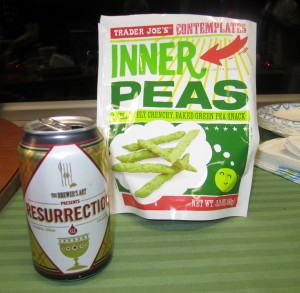
The night before we would all return home, our class had a party. Spontaneous. Food showed up on tables. People pitched in to arrange the space. Lots of talk. Lots of laughter. I walked over to add some snacks to my plate and laughed when I saw what a couple of clever folks had added to the offerings: From Trader Joes: Inner Peas. From Brewer’s Art in Maryland: Resurrection Beer.

Two things to remember as I ease back into life at home: Take time to be still and to cultivate the sense of living in the Divine Presence.  Have faith that God brings good from all things and invites us to be part of bringing Grace into the world, into our time and place and to rest in the Spirit that blows where it will.

And, when I forget, I just might pick up a bag of Inner Peas, wash them down with some Resurrection Beer and move into prayerful silence.

Being One

Being One

Andrej Rublëv -  Trinity

Andrej Rublëv – Trinity


First published in The Catholic Times, June 15, 2014  Volume 63:34

Easter season is over and we now begin the long liturgical period of Ordinary Time. This Sunday we celebrate Trinity Sunday. I’d like to reflect on this mystery by pondering Jesus’ words from last week’s readings. They speak of the coming of the Holy Spirit and the unity of all three Persons of the Trinity as well as our inclusion in Divine Life shared.

Last Thursday, in a reading from John, Jesus proclaims his heart’s desire in prayer. Approaching death, his thoughts turn to those who follow him. He doesn’t wish for earthly power or anything for himself, but desires that all those who believe in him may share in the union that he shares with the One who sent him. It is a prayer of love. A radical love.

Throughout his life, Jesus showed his disciples what that love looked like. It was washing feet. It was taking care of others. He told Peter, “Feed my sheep.” It was speaking the truth regardless of consequences. It was being with the outcast and those on the fringes of society. It was living simply with passion for the kingdom rather than for riches. While the words of that gospel are beautifully poetic, they demand sacrifice.

Jesus prays that all will come to perfection “as one,” not as individuals. We come to healing and salvation together with one another and with God. Our journey is not about personal salvation; it’s about the salvation of the world. Closing ourselves off from the problems of our world and pursing our own “holiness” would be easier. Leaving the messiness behind is tempting, whether violence, poverty, oppression, or care of the planet. Jesus tells us that’s not how it’s done.

I’m often overwhelmed by the challenges facing us and our world today. What can one person do? Is Jesus’ prayer too much to hope for? If we were on our own, the answer surely would be “Yes,” but he reassures us. We are not alone. We have Divine Love moving within us. “…I made known to them your name and I will make it known, that the love with which you loved me may be in them and I in them.”

On Pentecost we celebrated the coming of that Love, the Spirit. In that day’s readings Paul’s letter the Corinthians states that though we are many, we are one. The gifts of the Spirit are unique in each of us, but they are given for the same purpose: “To each individual the manifestation of the Spirit is given for some benefit.” When the challenges of our times overwhelm, we do well to remember this. Each one’s actions are joined with the actions of all others. God’s work is done by all together, healing all by the work God in all.

Sometimes what we do seems to make little difference whether at home, at work, or in the larger community, but we don’t see the whole picture. In spring, we plant seeds. That’s our part. What nourishes them and brings them to maturity bearing fruit, that’s Another’s work. We put small dormant kernels of life into dark earth, wait, and trust. Our call in the world is similar. We do our best and trust that God, gathering all our efforts, will do the rest.

The other two Pentecost readings gave us different accounts of the coming of the Spirit. One, from Acts, is dramatic: a howling wind driving through the house, tongues of fire descending. The other is quieter: Jesus came through locked doors to be with his disciples who were gathered in fear. “Peace be with you,” he said, and he breathed on them. The Spirit came with breath. Either way, the message is the same: The Living God is within us, the source of our gifts and our call as well as the power to be faithful to them.

Today’s feast celebrates the mystery of our God who is Relationship: Three persons dwelling in and with the other, and as Jesus’ prayer reveals, in us. The famous icon, “Trinity,” written by 15th century Russian painter, Andrei Rubelev, while picturing three angels has been interpreted by many to represent the Holy Trinity. The figures are gathered around a table, leaving open the place facing the one who views the icon. Perhaps it is an invitation to take our seat at table with the Holy Mystery and join in the Love and work of God.

© 2014 Mary van Balen

I Need Pentecost

I Need Pentecost

Photo: Mary van Balen-Detail Lectern Holy Trinity Church, Sloane Square, London

Photo: Mary van Balen-Detail Lectern Holy Trinity Church, Sloane Square, London

Of Sunday’s two readings describing the coming of the Holy Spirit to the disciples, I have always preferred the one from John’s gospel where Jesus on his followers huddled in fear behind locked doors and says simple, “Receive the Holy Spirit.” Never one for lots of drama and fanfare, this account is quiet. The Spirit comes with a breath. No one jumps up mysteriously speaking so everyone can understand no matter the language. No instant transformation. These same disciples are huddled together when Jesus returns again (Granted, he does come through locked doors. A bit of drama.)to show his wounds to the unconvinced Thomas.

All in all, the followers of Jesus needed some time to respond to the gift of Spirit. Life had been confusing. Jesus had been crucified. Nothing turned out as they had expected. The Spirit had a lot of work to do, sinking into the hearts and souls of these wounded and confused folks. They needed time.

Maybe that’s another reason I like this description of the coming of the Holy Spirit: It resonates. Life has not turned out as I had expected either. Does it ever? I need time to heal from the deeper hurts. I need time to get up from life’s more stinging blows and, when I do, to rebuild trust in this God of the Psalms who, despite being billed as our guardian and protecter, sometimes lets things slip by, at least from my perspective.

So, I basked in the Pentecost celebration at Mass yesterday, swaying to  songs with beats from Pentecostal to Caribbean. I soaked up joy and hope. This morning, as I read today’s Mass readings I stuck with the Psalmist’s prayer, “My help is in the One who made heaven and earth,” and know that, like the disciples, I will grow into  deeper trust and the peace that comes on the same breath as the Spirit

Grace Overflowing

Grace Overflowing

PHOTO: Mary van Balen

PHOTO: Mary van Balen

Originally published in The Catholic Times, May 11 2014 issue


Despite working until close at Macy’s on Holy Saturday night and arriving home around ten-thirty pm, I had energy and decided to bake hot cross buns. Well, I had energy until they were ready to rise the second time. Dragging, by three in the morning, I was savoring the warm, cinnamony-sweet results and cleaning the kitchen.

When the alarm sounded at 7:45, I wasn’t sure I could pry myself out of bed. “I could go to 11:30,” I thought. No. Nine o’clock was the mass I wanted to attend, sleepy or not. After a shower and a strong cup of tea, I headed out to St. Thomas the Apostle where the parish family was gathering to celebrate Easter.

The church was packed, and even though my usual place was taken, I found a seat next to a lovely older woman wearing an amazing hat. Remember Easter hats? As young girls, my sisters and I had new hats each Easter. Hats. Dresses. White gloves. Part of the ritual.

The altar was surrounded with flowers and on the ledge at the bottom of each stained glass window sat a potted spring bulb flower: hyacinths, tulips, daffodils. The tight buds were beginning to loosen, and hints of color were peeking out. A quite murmur rested in the church as people wished one another “Happy Easter” and caught up on the week before. Then the music began.

One of the many things I love about Saint Thomas is the spirited singing accompanied by a variety of instruments. Organ, piano, guitar, flute, drums, tambourine, trumpet, and on Easter I think I heard a trombone. Someone can set me straight if I’m wrong. It doesn’t matter really. What matters is that people are welcome to share their talents and that so many do!

I don’t remember all the songs we sang that morning, but I remember the joy with which they were sung, the clapping to the rhythm, the harmonies. A favorite “sprinkling” ritual at that parish is the procession up the center aisle to a large earthenware bowl that holds baptismal water. Pews empty out one by one, and when each person reaches the bowl, they dip their hand into the water, turn, and make the sign of the cross on the forehead of the person behind them, all the while belting out Marty Haugen’s song, “Up from the Waters.”

“Up from the waters, God has claimed you, Up from the waters, O child of Light. Praise to the One who called and named you, Up from the waters into life…”

Choir members brought up the end of the line, the last two keeping time with their instruments. The tall gentleman who played the tambourine was last. Having no one behind him to bless with the water, he turned, raised his hands and shook the tambourine making a large sign of the cross: He blessed us all, and we applauded our “amen.”

The responsorial song was sung with a strong voice and a bright smile.

And so it went. The celebrant chose to read the Gospel from the Easter Vigil Mass where the two Marys, having been told that Jesus had risen ran “overjoyed” to tell the disciples. They saw Jesus on their way.

The theme of joy ran through his homily, and with a child’s abandon, a young member of the congregation punctuated one of Fr. Denis’s comments with a heartfelt, “Yeah!”

It fit.

A sung Eucharist Prayer, shared peace, shared communion. The wine was sweet. Sun poured into the windows, waking the flowers as we sang our Alleluias and closing hymn. No one was in a hurry to leave. I told the lady next to me how much I liked her hat, then found some friends who had been across the aisle and exchanged Easter greetings.

I lingered, soaking in the Mystery and Grace, and then made my way across the parking lot. Coming out from the common room in the basement, a few people were carrying boxes of candy-filled plastic eggs to scatter for the Easter egg hunt that would follow the later Mass.

Waiting for the traffic light at the corner to change, I looked at the green grass beside the rectory and church. It was absolutely covered with colored eggs. An abundance. I hadn’t kept Lent particularly well, yet there it was, God’s gift of Self overflowing. A never ending Fountain Fullness as a Franciscan friend says. I put down the car window, waved, and took a deep breath, glad I had pulled myself out of bed for nine o’clock Mass.

A joyful Easter Season to you all.

© 2014 Mary van Balen

Lent: Winter, Flowers, and Pete Seeger

Lent: Winter, Flowers, and Pete Seeger

retreat bouquet from daughtersOriginally published in The Catholic Times, March 9, 2014 issue

A lover of winter, even I am ready for spring this year. Snow, ice, and frigid temperatures just keep coming. And coming. As I arranged a small “prayer table” in my dining area, I decided to add flowers. Some years I have placed small branches in a vase or a container of stones and bulbs, forcing them to sprout and bloom by the end of Lent. This year, I am starting with blooms. I’m not feeling particularly “spiritual.” I need a reminder that even in the midst of winter, spiritual as well as physical, God’s love is present.

Besides flowers, the space holds a book of Scripture readings, a Tibetan singing bowl to call me to prayer, a small, bronze cross, and some bits of nature gathered or given by friends. A candle sits atop a tall wrought iron stand fashioned for me by my daughter many years ago. For some reason, this year I think I will need all these sacramental objects to keep me focused and hopeful.

It’s not just winter weather that has made my spirit weary. Life has been busy with writing projects, healing, and work. News of world conflicts, genocide, drought and famine, while not unique to this moment, weighs particularly heavy on my heart. Closer to home, political rancor and intolerance continue to grab headlines. Our world needs hope. It needs Easter.

Winter has not been without moments of beauty and grace. One was a sing-along gathering people from around the city to remember and honor Pete Seeger who died at the end of January, ninety-four years young. Parking a few blocks away from the Mennonite church where it was held, I joined others walking in the street to avoid icy, unshoveled sidewalks. The space was packed. Led by a trio on guitar, banjo, and bass, we raised our voices (in harmony, no less), singing the old songs. It felt good. The day Pete Seeger died, I took my guitar out from under my bed and played for a couple of hours, wondering why I didn’t do that much anymore. Singing and playing are prayer for me, much like writing.

“This Lent, I’ll sing more,” I told myself.

Pete Seeger used to say that we shouldn’t wish for a great leader. Instead, we should hope for lots and lots of good leaders who work hard right where they are. Think globally. Act locally. It will be participation that saves the world, he’d say.

Lent is like that for me, this year. I’m trying to nurture the awareness of being part of something much bigger than myself, bigger than my little world of home and work, family and friends. Jesus gave us the big picture, the call the help in bringing the kingdom. But he calls us to
“act locally.” He didn’t ask his followers to become national figures or world leaders. He called them to love one another. To respect and to serve, right where they were.

When those he healed wanted to go with him, he often told them to stay put and tell their story to those with whom they lived and worked. It’s harder to do that. Leaving one’s routine behind sounds exciting. It’s easier to love people we don’t know that well.

It’s easier to think about big events and projects than about calling our political representatives, taking time to visit with a grumpy neighbor, or becoming aware of how we might live more consciously of our effect on the planet. Following Jesus is more little steps than giant leaps. It’s more nitty-gritty than glitz.

Lent’s about embracing death, sure of life to come. It’s also about enjoying flowers in the wintertime. It’s about giving ourselves down time to remember that even when we don’t feel God with us or in our world, the Holy One lives in us all. Lent reminds me of this winter that prepares the earth for spring.

© 2014 Mary van Balen