In Remembrance and Solidarity

PHOTO: Mary van Balen

PHOTO: Mary van Balen

This evening I joined a gathering of people at Trinity Episcopal Church for a prayer vigil of remembrance and solidarity following the violence in Orlando. People of various denominations, faiths, and communities celebrated in a simple service that included silence and music—not too many words. Being together in the Holy Presence of Love, however one names it, was enough.

I felt a profound sense of peace sitting in that welcoming church. Clergy and community leaders spoke and shared their thoughts and voiced prayer for all: an Episcopal priest, Methodist minister, Jewish rabbi, Islamic leader, a member of the LGBT community, and a representative of the Ohio Coalition to Stop Gun Violence.

Perhaps the most moving moments were those spent standing in silence, listening to the bell toll 50 times, once for each life lost.

We held candles during the final musical piece and benediction. “What’s a vigil without candles?” rector Rev. Richard A. Burnett asked.

True. Candles bring light into darkness, a symbol of Love, of prayer, which do the same.

a round tray filled with sand and small, lit tea candles

PHOTO:Mary van Balen

Note:

As we left the church, a table held information from a number of community organizations that invited participation.  Love is the motivator, the power. But, as Stephen Colbert said as he began his show after the attack: “Love is verb. Do something.” It’s not enough to remember. Each in our individual way must make Love live. One suggestion? In November,  vote, and vote to elect those who will not build on hate and division, but who will work for the common good and protect the civil rights of all.

To the Face of Evil, Bring Love

To the Face of Evil, Bring Love

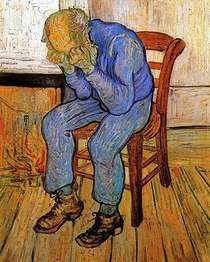
Old Man in Sorrow - Vincent van Gogh 1890

Old Man in Sorrow – Vincent van Gogh 1890

Before heading out to work this morning, I’m heading to church. Drawn there by grief and not knowing what else to do. The hate and fear that could move one human being to massacre innocent people is unfathomable to me. As is often the case in the face of such horror, I feel helpless.

The temptation is to hate back. But if we do, hate wins.

Facebook is full of quotes and suggestions. One counseled kindness. Be especially kind today at work and as you go about your day. You have no idea who may be “suffering quietly” after Sunday’s massacre. Good advice at any time, but particularly today. How often do those in the LGBTQ community and those who love them  suffer quietly, their pain and struggle held close and out of sight?

Today I will try to love and live in a way that fosters peace. They will be small ways. I’m not a celebrity whose words will be quoted. I’m not in a position of power to make laws or change the ones we have. At least not quickly. Most of us are not.

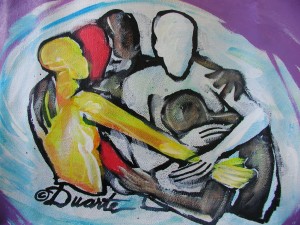
modern painting circle of five people in an embrace

Painting by Richard Duarte Brown

But we can refuse to hate, as difficult as that can be at times like this. We can refuse to blame entire religions (Some would like to point fingers at Islam, others at Christianity.). We can offer comfort, listen, pray. We can grieve with those who have lost family and friends, who have lost any sense of safety. We can make our voices heard by speaking up and communicating with those who are political and religious leaders.

But I think, most of all, we can live our ordinary lives with love and compassion. We can walk forward calling on the power of infinite Love in the face of evil. And have hope. What else is there to do?


Lent: Come As You Are

Lent: Come As You Are

small table with purple cloth, candle, cross, shells, feather, for Lent

Photo: Mary van Balen

Lent comes quickly this year. “That’s why I’m not ready,” I tell myself as I sit quietly and ponder this column. I wanted to be more centered. I wanted my office to be straightened up, desk uncluttered to better concentrate. I wanted to have prayed more, read more, been still more. But, here I am, on the brink of Lent, behind in lots of things, and not prepared for the season at all.

Or maybe, that’s how we are meant to greet this liturgical season: No big preparations. No cultural hoopla like the marketing blitz that accompanies the coming of Christmas. This is a “come-as-you-are” event, and usually, this is how I am.

I’m pulled in many directions, full of good intentions and forgotten resolutions. Jesus has words for me in this Saturday’s gospel. When the Pharisees ask him why he’s hanging out with the sinners and riff-raff, he seems a bit surprised. Why wouldn’t he? After all, he says, those who are healthy don’t need a physician; the sick do.

So as Lent approaches, I console myself with the thought that I fit right in. Jesus isn’t expecting my office table to be clear of papers, bills, and books. He knows me too well. I think he’d feel right at home at my dining room table. It hasn’t had a tablecloth on it since Christmas. Instead, it’s been home to my daughter’s 3-D printer that arrived during her stay as she recuperated from a broken foot.

And he wouldn’t mind eating leftovers or a hastily prepared meal after I return from a long day at work. No, as I read through the Mass readings before and after Ash Wednesday, I began to relax. If I’m willing to slow down and sit with Jesus at my table and in my heart, no matter the mess, then I’m ready for Lent.

Last week, a group of friends and I shared dinner, conversation, and prayer. One woman played a song, Pilgrim, by Enya, and this line caught my attention: “All days come from one day/That much you must know/You cannot change what’s over/But only where you go.”

All days come from one day. “That day is this day,” I thought. The present day, the only one we have. Paul says something like that in Ash Wednesday’s second reading: “In an acceptable time I heard you, and on the day of salvation I helped you. Behold, now is a very acceptable time; behold, now is the day of salvation.”

Now, this moment, is the acceptable time. This day. And then the day that follows. And the day that follows that. One day at a time is the day of salvation. The anonymous author of The Cloud of Unknowing puts it this way: “Therefore, be attentive to time and the way you spend it. Nothing is more precious…God gives only the present, moment by moment…”

The thing is, I’m often not there. Not following Enya’s wisdom, I’m tempted to rethink the past, allowing regrets and sorrow from yesterday’s pain to capture my attention. Or I can spend time speculating about future scenarios for family, friends, and our world.

What grace to have this liturgical season to remind us how important it is to embrace each day along with its joys and sorrows; to trust that “this day” has something good for us, or at least that some opportunity to grow, something good can come from it.

What blessing to have the wisdom of those who have gone before us. It’s a mixed-up crowd we walk with, this “communion of saints,” canonized or not, living or dead, who recommend ancient disciplines of prayer, fasting, and almsgiving for our journey through Lent.

There are as many ways to observe these directives as there are people who follow them. One may do well to abstain from food, another from “screen time.” One may need to give herself permission to celebrate who she is, while focusing on others might be the call for someone else. Maybe we give time, money, or talents. Perhaps the grace is in receiving what is offered.

But, what it comes down to is spending these forty-days shedding what gets in the way of attending to God-with-us. It’s about nurturing ways of being that help us listen to the Holy One within and believe the amazing truth that God loves us, calls us to share Love in this world, and will help us do it. It’s about choosing to live as fully as we can, trusting that all days will come from the one day lived well.

© 2016 Mary van Balen

Surprised by Pope Francis: Day and Merton

Surprised by Pope Francis: Day and Merton

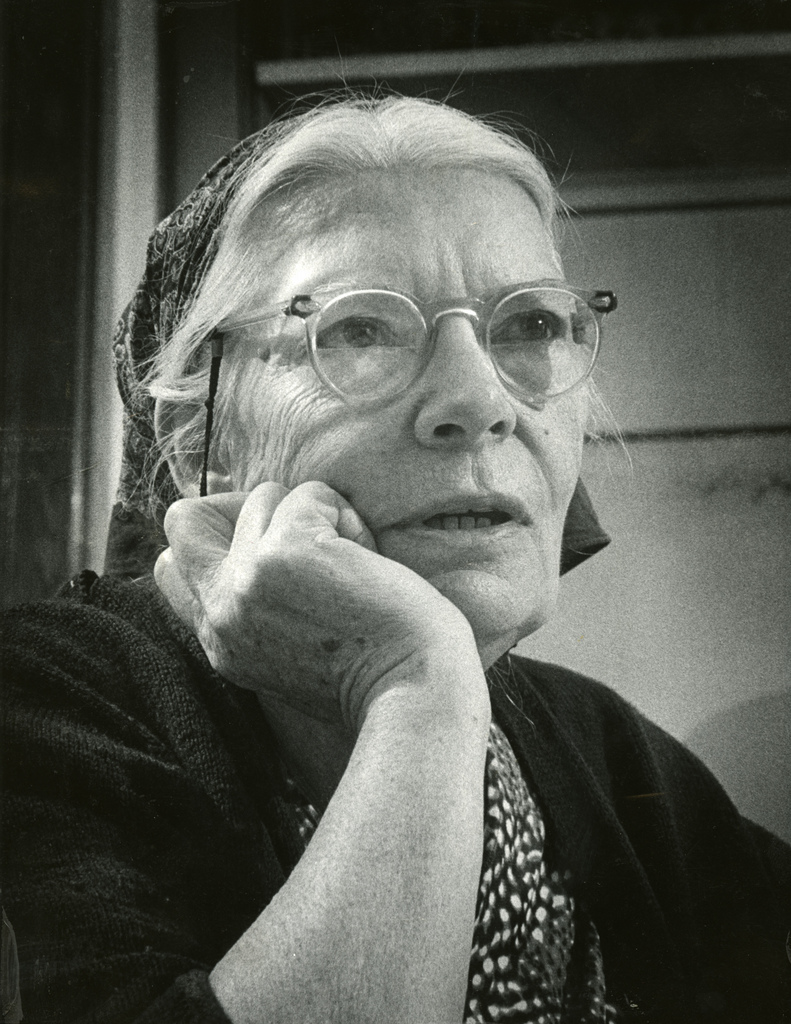
Close up of Dorothy Day

First published in The Catholic Times, October 11, 2015 issue


I stayed home from work the morning that Pope Francis spoke to the United States Congress. I wanted to watch his face and the faces of those gathered to hear him: A congress mired in partisan politics, hopelessly polarized. What would Pope Francis say to them? To the country? How would our elected officials receive his words? It was a moment I wanted to witness as it unfolded.

The pope did not disappoint. Just a couple of weeks ago, at a gathering of citizens concerned about issues of social justice and a stalled political system, a gentleman expressed dismay that the concept of the common good was no longer a topic in public discourse. Pope Francis took care of that.

He had barely spoken a hundred words when he directed attention to our solemn responsibility for the common good. “You are called to defend and preserve the dignity of your fellow citizens,” he said to the lawmakers, “in the tireless and demanding pursuit of the common good, for this is the chief aim of all politics.”

By now, most who read this column will have read (or heard) various commentaries on the address and what the pope did and did not say. But, what surprised me was how he said it: He used the example of four great Americans who gave their lives to service and to the betterment of society. Two, Abraham Lincoln and Martin Luther King, Jr., often serve as inspirational examples, fittingly so.

The other two are the ones I didn’t expect: Dorothy Day and Thomas Merton. In my late teens I read a number of their books. They influenced my faith and spirituality. Still, I wondered, how many of the government officials sitting in the room knew those names? How many watching and listening around the country wondered who they were and searched for them on mobile phones and tablets?

They’d find Dorothy Day, born in 1897, was a radical who advocated for women’s suffrage, a pacifist who opposed all wars, and a tireless worker for social justice who saw the need not only to serve the poor she encountered in daily life, but also to change the system that created such poverty and injustice. She was a writer and journalist who gave voice to marginalized people and causes.

A convert to the Catholic faith that fed and sustained her, Dorothy attended daily Mass, read scripture, and wove prayer throughout her days. As a friend who once heard her speak said, “She was prayer.

Dorothy, along with close friend Peter Maurin, founded “The Catholic Worker” newspaper and the movement of the same name. Catholic Worker Houses continue to welcome the poor and are places where the corporal works of mercy are lived out. As Pope Francis encourages, they are places of encounter.

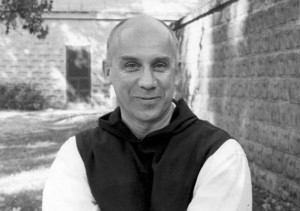
The pope spoke a second name that I didn’t expect to hear: Thomas Merton, a Trappist Monk at the monastery of Gethsemani, in Kentucky. We celebrated the 100th anniversary of his birth this year. Pope Francis singled him out for his openness to dialog with others of all faiths, seeing them as pilgrims on the same search for ultimate truth. His last journey was to Bangkok where he attended an international conference on monasticism, organized by Buddhist monks. Like Day, he calls us to deep encounter with those unlike ourselves.

Thomas Merton standing outside Pope Francis also recommended Merton’s openness to God in a contemplative style of prayer. Merton in the midst of a world immersed in “noise” of all types—digital, visual, aural—pouring out of players, electronics, out of the depths of our souls, calls us to quiet presence. For those who fill up every moment with activity and distraction, he says, “Be still. Listen.”

Like Dorothy Day, Thomas Merton was a writer and a convert. His books addressed spirituality and political topics. He was an outspoken critic of the Viet Nam War and the arms race.

Two people of deep faith and prayer: One active in the world, the other a monk responding to world issues with his pen; both social activists who pointedly challenged the status quo and whose words speak to us today. Immigration, poverty, climate change, racism, and violence require bold responses from all of us, not only governments.

If you’re not familiar with Dorothy Day and Thomas Merton, consider reading some of their work or finding out more about their lives and spiritual journeys. Pope Francis’ choices challenge us all.

© 2015 Mary van Balen

Pope Francis and the Common Good

Close up of Pope Francis addressing US Congress 9 24 2015


This past Sunday, while spending an evening with the Nuns on the Bus, I heard one man say that the words “the common good” had all but disappeared from public discourse. Today, Pope Francis put it back—front and center. He stood before Congress and in the first minutes of his speech, reminded those legislators: “You are called to defend and preserve the dignity of your fellow citizens in the tireless and demanding pursuit of the common good, for this is the chief aim of all politics.”

I hope they were listening.

The organization of the Pope’s speech was masterful. He reminded us of values and struggles for liberty, freedom for all, social justice, and openness to dialogue and prayer by holding up four Americans: Abraham Lincoln, Dr. Martin Luther King, Jr., Dorothy Day, and Thomas Merton. Many of his listeners may not have heard of Dorothy Day or Thomas Merton. Their lives and writings were integral to the development of my own values and spirituality in my late teens and early twenties. Thomas Merton’s books have a place in my study, and his quote from his theophany at Walnut and 42nd in Louisville, Kentucky hangs on my wall.

Pope Francis highlighted the need to address poverty and climate change. To welcome refugees and those seeking a better life. He warned against reducing complex issues of violence done in the name of religion to labels of “righteous” and “sinners.”  When speaking of the need to  respect life in all its stages, he called for an international ban on the death penalty. Throughout the fifty-some minutes that he spoke, he emphasized the imperative of working not for wealth or personal power, but for the good of all.

And, in a place where it has been tragically lacking, he called for cooperation:  “We must move forward

together, as one, in a renewed spirit of fraternity and solidarity, cooperating generously for the common good. The challenges facing us today call for a renewal of that spirit of cooperation, which has accomplished so much good throughout the history of the United States.”

Pope Francis in front of assembled US Congress.

Pope Francis addressing US Congress 9 24 2015

Life the man himself, Pope Francis’s speech was also full of hope and optimisim. Of joy and love.

And then, when he finished, he left the halls of Congress and the assembly of rich and powerful to share lunch with homeless of Washington.


Encountering the Other

Encountering the Other

modern painting circle of five people in an embrace

Painting by Richard Duarte Brown

Originally published in the Catholic Times, 9. 1315

A few days ago, while driving to work, I heard a story on NPR about the thousands of immigrants arriving on the small Greek island of Lesbos, refugees fleeing war and oppression in Syria, looking for a place to live. They risked a dangerous journey leaving everything behind and set off toward an unknown future. Husbands and wives, parents and children, friends and relatives, all willing to trust their lives to people and places they do not know.

Listening to reporters interviewing newly arrived refugees, I marveled at the joy in their voices. Thrilled to have survived the journey and to be standing on solid ground in a place free of war and the atrocities that accompany it, they spoke with such hope, such faith in God, or if not in God, in fellow human beings.

I wanted to rejoice with them, but concern tempered my delight as I wondered what the road ahead would bring for them: Mounds of paperwork and bureaucracy from governments hesitant to welcome so many people needing work and aid. Hostility and resistance from those who will feel threatened by their presence, by their “otherness.” Soon, frustration will replace the euphoria of the refugees’ first taste of freedom from constant fear and suffering.

Tragedy already darkens Syrian refugees’ arrival. The United Nations refugee agency reports that over 2,500 people have died this year trying to make the dangerous ocean crossing.

Driving home from work that same day, I heard an inspiring story of Icelanders who had formed a Facebook group, “Syria is Calling,” and is pressuring their government to take in more than the 50 refugees it had offered to accept—a lot more, 5,000. While the large number of people the group is proposing to welcome is impressive, it was the outpouring of individuals’ willingness to help that stirred my heart.

People offered to open up extra bedrooms in their homes and provide food, money, and house wares to help new arrivals settle in. This personal response is more demanding than putting a check in the mail, which is my plan. It means living with people who have different beliefs and values. In some cases, like sharing one’s home with strangers or welcoming them into your city, such action means daily encountering the “other” with openness and reverence for their personhood. It means, in the midst of serious complexities, maintaining the belief that we are more alike than different.

This post from “Syria is Calling” eloquently proclaims this truth: “Refugees are our future spouses, best friends, our next soul mate, the drummer in our children’s band, our next colleague, Miss Iceland 2022, the carpenter who finally fixes our bathroom, the chef in the cafeteria, the fireman, the hacker and the television host. People who we’ll never be able to say to: ‘Your life is worth less than mine.’”

These words challenge all of us around the globe to examine our own attitude toward the “other,” not only the Syrian refugees, but the marginalized people who live in our own cities and neighborhoods.

The Letter of Saint James, included in this Sunday’s readings, speaks forcefully about the responsibility of Christians to put their faith into action: “If a brother or sister has nothing to wear and has no food for the day, and one of you says to them, ‘Go in peace, keep warm, and eat well,’ but you do not give them the necessities of the body, what good is it? So also faith of itself, if it does not have works, is dead.”

Fear of those who are not like us is no excuse; it is a human failing that must be confronted and transformed by love, a process that can take a lifetime. It is a process that requires encounter.

But suffering and injustice can’t wait for lifetimes. Our faith, our humanity, requires action before we are comfortable. We must respond with love despite our fear, and incrementally, our hearts will change. As Jesus said, love will cast out fear. We are all other to someone. Encounter will transform us: those in position to give and those who receive, privileged with voice and marginalized with none.

© 2015 Mary van Balen

When Spring Freezes

When Spring Freezes

PHOTO: Mary van Balen

PHOTO: Mary van Balen

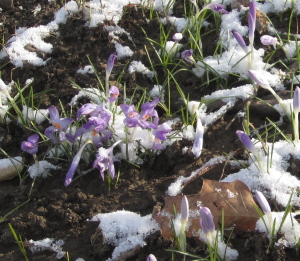
I couldn’t believe my eyes. Not only were the crocuses in my neighbor’s lawn blooming in early March, they were covered with bees! After months of sub-freezing temperatures, inches of ice, and more inches of snow, the earth had warmed enough to coax beautiful purple flowers out of their dark waiting place. Spring, it seemed, had arrived.

Passersby stopped to see what enticed me to stoop low and look closely. “Bees,” I said. “Bees are all over these flowers.”

Some stopped long enough to look themselves. After a frigid winter, we were ready for a change.

Spiritual life can be like that. Sometimes winters of the soul seem to last forever. Then, just when we’ve come to terms with the possibility of unending cold and emptiness, everything changes: Hope wakes up and shakes her feathers. Life erupts like the crocuses. Intoxicated, we nuzzle down into the golden centers and rise up heavy with life-giving pollen sticking all over. Unable to contain our joy, we move from hope to hope, from beauty to beauty. Like bees, we’re called by Mystery to an ancient dance, and we join in, spreading the sticky grace and picking up more everywhere we go.

PHOTO: Mary van Balen

PHOTO: Mary van Balen

Then, as quickly as it left, the cold returns. The crocuses across the street are suddenly bowed under a fresh fall of snow. Bees have disappeared to wherever it is they go to escape the freeze. A collective sigh rises from the earth. People bundle up in winter coats again. The few days of warmth make the cold bite deeper, and we shiver in temperatures we would have welcomed a month ago.

Spiritual spring can be just as fickle. Fear or worry blow in from somewhere and hope retreats. Sticky grace feels more like goo. We’re not flitting from  hope to hope. We’re not moving at all. A groan rises from deep inside. The emptiness seems larger after having danced with Joy.

“It won’t last,” we tell ourselves but struggle to believe it.

It’s a good time to listen to music or to sit in the dark and gaze at stars, or a candle, or nothing.  We might curl up with a good book of poetry, or linger with scripture. Story reminds us that this dance with winter and spring is nothing new. If we can settle in with the cold and dark, we discover they  have gifts of their own. And it doesn’t last forever.

Eventually, sun will melt the snow. Flowers will straighten their stems and lift their heads. The bees will come back, and we’ll feast on sticky Grace.

PHOTO: Mary van Balen

PHOTO: Mary van Balen

Love Rules the Day: St. Scholastica

Love Rules the Day: St. Scholastica

PHOTO:Mary van Balen

PHOTO:Mary van Balen

Originally appeared in The Catholic Times, Feb 8, 2015

Tuesday, February 10 is the feast of Saint Scholastica. What we know of her comes from St. Gregory the Great’s famous biography of St. Benedict, though other stories were later written about her. Scholastica is Benedict’s twin sister, both born into a wealthy family of Nursia, Italy in 480. As was the custom, Benedict went to Rome to study while Scholastica likely lived in a convent where she learned to read and write as well as participated in the prayer life of the nuns.

Some stories recount her founding a religious community near her brother’s monastery at Monte Cassino, and becoming prioress. The most famous account of her, though, is found in chapters 33 and 34 in Book II of Gregory’s Dialogues.

As was their custom, once a year Benedict, accompanied by some of his monks, met his sister at a house partway between her convent and his monastery. They shared food and conversation concerning spiritual matters. On this particular visit, just three days before her death, Scholastica wanted her brother to stay longer. Perhaps she sensed it would be their last time together. They talked until darkness fell, and she asked him to spend the night “…that they might spend it in discoursing of the joys of heaven.”

Benedict would have none of it, saying that he couldn’t spend the night away from the Abbey. That was the rule, after all.

Not giving up, Scholastica put her head down on the table, laying it on her folded hands, and prayed. As she prayed, a storm came and filled the clear night sky with thunder and lightening. She lifted her head, tears streaming from her eyes, and heavy rain poured from the heavens. Benedict and his monks couldn’t return to the Abbey in such a storm.

“God forgive you, what have you done?” Benedict asked. Scholastica answered with a bit of attitude: “I desired you to stay, and you would not hear me; I have desired it of our good Lord, and he has granted my petition. Therefore if you can now depart, in God’s name return to your monastery, and leave me here alone.”

Of course, Benedict and his monks spent the night, the brother and sister enjoying long conversations until morning. Love, it seemed, trumped the Rule, at least in this case. As St. Gregory wrote: “He found, however, that a miracle prevented his desire. A miracle that, by the power of almighty God, a woman’s prayers had wrought. Is it not a thing to be marveled at, that a woman, who for a long time had not seen her brother, might do more in that instance than he could? She realized, according to the saying of St. John, “God is charity” [1 John 4:8]. Therefore, as is right, she who loved more, did more.”

Whether truth or legend, the story shows the power of love and the importance of listening with the heart. Benedict was right in stating that he and the other monks should return to the monastery. Yet, Scholastica’s desire, born of deep affection for her brother and her longing to continue their conversation and praise of God together, was worthy of bending the rules, even Benedict’s.

How often are we confronted with such a choice? Can you recall times when rigidly holding fast to a tradition or rule has worked not to foster growth and love, but instead to injure and alienate? Clinging to what we think we know is “right” may blind us to the reality of others’ lives and wisdom.

Rules and traditions are important. Benedict’s Rule has proven itself over centuries, leading monastics, helping them live, work, and pray together in community. It has also been a guide for many as they strive to balance prayer, work, study, and recreation in their lives with family and friends, and in their workplaces.

Benedict understood the necessity of responding to particular moments and particular needs in ways that are outside the usual response. His Rule is full of such examples. Still, in this story, it was Scholastica who was listening with the ear of the heart and who found God listening to her.

© 2015 Mary van Balen

Hang In There

Hang In There

PHOTO: Mary van Balen

PHOTO: Mary van Balen

We are not among those who draw back and perish, but among those who have faith and will possess life.  Hb 10, 39

This morning’s Mass readings were full of “words” that spoke to my heart: Not throwing away what you have been given. Seeds growing, we know not how. The tiniest of seeds becoming the largest of plants. As I sat quietly in prayer, I became aware of the plants that line up along my buffet in front of the window. Of the Peace Lilies, one huge, that filter the air I breathe. Of the mystery of how they grow, turning sunlight into what they need, and how they serve me and the planet. Mystery. So much I can never know.

But it was the line from Hebrews that struck deepest. I think because I’m sometimes among those who draw back. Life isn’t easy for any of us, regardless of appearances. Like the life of the peace lily, it’s full of unknowables. In the face of darkness I’m tempted to forget the Light. In the presence of silence, I’m tempted to forget the Song. Or worse, not believe that Light and Song are out there (or in here) at all. I keep on keeping on, as Pete Seeger and Woody Guthrie urged, but without much heart or expectation.

That’s the perishing. The death of hope. The closing up.

The line from Hebrews encourages us to keep the faith. The Holy Mystery doesn’t withhold Life. No. Life is always gushing out. Like rain, it falls everywhere, on everyone. Those hurt or pained by life’s unfair twists and turns may close up tight. The rain of Life runs all over them, but can’t get in. Or can it? God isn’t so easily evaded. Like the rain, Life falls into the soil around each soul, soaking deep into that which holds its roots. Life, sliding off the closed bloom, quietly moves up the stem, sucked up by the inborn will be. The Presence that falls on the outside resides in the center as well.

I think of those for whom just choosing to live is a day by day challenge. Their “yes” to life is as much opening as they can muster. And it is enough. For those of us for whom simply living does not require daily assent, but challenges our perseverance, closing up tight may be the best we can do on some days. That is enough,too.

Thankfully, God-Life keeps pouring out, never giving up on us even when we give up on God, and eventually, we gather enough green sap to chance opening again. When we are able, we discover not only that we possess Life, but Life has possessed us all along.


No Place is “Nowhere”

No Place is “Nowhere”

PHOTO: Mary van Balen

PHOTO: Mary van Balen

“When he looked, although the bush was on fire, it was not being consumed. So Moses decided, “I must turn aside to look at this remarkable sight. Why does the bush not burn up?” When the Lord saw that he had turned aside to look, God called out from the  bush: “Moses! Moses!” He answered, “Here I am.”  EX 3, 2b-4

I read Sunday’s morning prayer from my “Give Us This Day” book and, though the story was familiar, something about it seemed fresh. I guess it was Moses, talking to himself, wondering out loud why the bush wasn’t consumed by the fire and telling himself he should take a minute and check it out.

It was the words, “turn aside to look” that caught my attention. God wasn’t calling out all along…just after Moses stopped to look. Or was the Divine call constant and Moses just heard it when he quit going about his business of tending the flock and got quiet enough to listen?

I’m having trouble listening these days. Weeks of being in bed or on the couch, sick, coughing, and nursing an ear infection haven’t helped. At first, I thought they would. While home from work I would catch up on some reading, do a bit of writing, and you know, just be better at all the stuff I’m usually too busy to do. Sickness doesn’t  work that way. My eyes hurt and trying to read made me dizzy. Writing was out of the question. Mostly, I put on Netflix and fell asleep watching reruns of old TV shows. Then of course, came the attack of unwanted thoughts and recriminations.

“Why haven’t I gotten more done?” “I’ll never finish readings for this course. I’m probably no good at it anyway. Maybe I should quit.” It didn’t take long before the worth of my entire life was in question and the future looked particularly dim. Didn’t help to learn a week into antibiotics and cough syrup, that the store where I work was closing in March. The job I’m not crazy about looked much better from the vantage point of not having one at all. Life. Not all it’s cracked up to be.

Then comes Moses. He meets God in a bush out in the middle of nowhere. “That’s me,” I think, “out in the middle of nowhere.” But can a place be nowhere if God hangs out there? I mean, what puts a place on the map if the possibility of running into the Big Kahuna doesn’t?

That’s hopeful. No place is “nowhere” if  what is most Sacred dwells there. That includes places like work, a dirty kitchen, or a tissue cluttered couch. Even a sick, tired heart.  The problem is the Holy Mystery is exactly that, a mystery, and doesn’t seem inclined to catch my attention with lights or voices. At least not that I notice. And there’s where Moses comes in. He told himself he ought to take a closer look. While I’d be better at noticing if the people or objects holding this Divine Presence were marked with roaring flames, I’m giving attentiveness a shot, again.

Quiet time in the morning before life gets rolling too fast to stop. Noticing the sun painting warm orange colors on the clay pot that holds a fledgling peace plant. Accepting the graciousness of co-workers who worked extra hours while I was languishing at home. Finding a container of homemade soup placed in my refrigerator so I would have something easy and healthy to eat after my first day back to work. Calls from my kids, just making sure their mom was getting better. The smile of a customer.

There are challenges, too. Trusting I’ll find a job with health benefits. Hoping in the face of a country that seems run by big money and a world torn by racism and violence. Believing when prayer doesn’t seem to make a difference. Expecting to find Presence and Grace when I take time to be still and take a closer look at the ordinary stuff that fills my day.