God’s Love Is Always Big

God’s Love Is Always Big

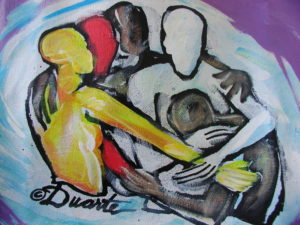
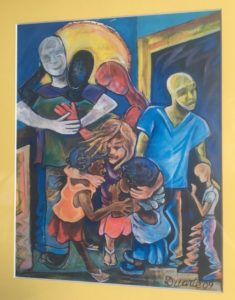
Colorful abstract painting of people of all ages and races embracing

Acrylic – Richard Duarte Brown 2009

Originally published in The Catholic Times, March 11,2018

One of the scribes came to Jesus and asked him, “Which is the first of all the commandments?” Jesus replied, “The first is this: Hear, O Israel! The Lord our God is Lord alone! You shall love the Lord your God with all your heart, with all your soul, with all your mind, and with all your strength. The second is this: You shall love your neighbor as yourself. There is no other commandment greater than these.”  Mk 12, 29-31

For Jesus, it’s all about love. Love of God. Love of self. Love of neighbor. When asked which commandment is the greatest, Jesus quotes from Hebrew Scriptures. First from Deuteronomy, proclaiming that God is one and that love of God is the most important “law” in one’s life. Then from Leviticus, Jesus quotes from a long list of commands given by God to Moses and says “You shall love your neighbor as yourself” is the second great commandment.

There is it. Love. Nothing else is more important. Matthew’s gospel includes Jesus saying that “The whole law and the prophets depend on these two commandments. It all boils down to love.

Of the three, I wonder if “loving self” might be the most difficult. It isn’t easy. And as Jesus knew, when we can’t love ourselves, loving anyone else is close to impossible. That tiny phrase “as yourself” carries a lot of weight.

Most of us are aware of our faults. We can become preoccupied with them and tied up in minutia, focusing on what’s wrong with ourselves and with others. We forget about love and end up fixated on rules, who’s keeping them and who’s not. We can even believe that God’s keeping score as we struggle through life. It’s easier than tackling “Love.”

Recently I spent an evening with a small group of women who had been gathering at one another’s homes for decades. Being mothers brought them together. Now grandmothers, they still meet, supporting one another and engaging with invited speakers. That night, I was the speaker, and our topic was “compassion.”

What struck me during our time together was that no matter how insignificant moments of love might seem, they never are. Encounters with Love are always transforming.

Once when I was about ten, I remember telling my mother she was “the worst mom in the world” and storming off to vent to her mother, who had always lived with us. I can’t remember what triggered my anger. (Mom was one of the best!) I do remember my Grandmother’s response.

She listened as I recounted my grievances. She didn’t interrupt or try to correct me. No lecture. No defense of Mom. After a pause she smiled and asked if I’d like to play a game of Canasta.

That was it. Love and healing came not with flash but with a game of cards. I couldn’t have worded it then, but her invitation said volumes about me being ok, someone she’d like to spend time with. Someone who was hurt and needed nothing more (or less) than graceful Presence.

In the scheme of things, barely a drop in the bucket. But love is never small. Once received, it changes the giver, the receiver, and ripples out.

I thought of my friend, a “missionary of Presence” in a small village in the Guatemalan rainforest. Her December newsletter recounts the transformation of women who were stigmatized by being alone, abandoned by their husbands, and left to provide for their families. She gave physical assistance but realized they needed more.

So they gather twice a month, read scripture, pray, share their stories, weep, and laugh. They know they are somebody. They are loved and now have more love to give away.

Love is powerful, but not easy. One woman in the small gathering I had been asked to attend made that point with a question. The Parkland school shooting had occurred just days before. “Do we have to show compassion to the shooter?” Silence. Then a number of voices said “Yes.”

With Love there are no exceptions. Such inclusive Love is hard to take. We’d rather draw lines, “them” on one side, “us” on the other. In some cases, it seems the reasonable thing to do. But God doesn’t see our lines. No one is beyond God’s embrace. Not our fault-filled selves, not those we close out, not the shooter.

By ourselves, we can’t be such love in a world that’s aching for it. With God’s love transforming us from the inside out, we can. After all, it’s God’s love we’re sharing.

© 2018 Mary van Balen

The “Both/And” of our Our Faith

The “Both/And” of our Our Faith

Photos: Mary van Balen
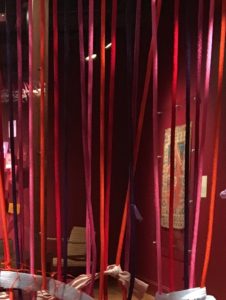
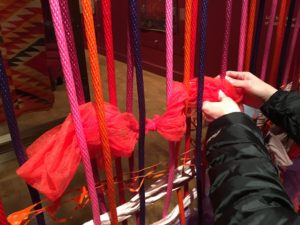
Weaving in progress at the Columbus Museum of Art 12 2017

Originally published in The Catholic Times, December 10, 2017

I looked up the word “advenio” in my old Latin dictionary and found that depending on how it’s used, the verb can mean “to draw near” or “to arrive.”  The noun, “adventus” is also translated as either “approach” or “arrival.” The season of Advent encompasses both. We wait. We celebrate what has already come. It’s the “both/and” of our faith. God is coming. God is already here.

During this season, we ponder that mystery and our participation in it. Liturgical readings are one place to start. For example, the first week of Advent is filled with passages from what is often called “First Isaiah” and provides glorious images of the kingdom to come: people from all nations streaming up the mountain of God, desiring to learn and walk in God’s ways; a kingdom where all live together in peace; great feasts where God provides rich food and choice wine for everyone.

Isaiah paints more pictures: justice for the poor and vulnerable, abundant harvests, broad pastures and running streams. He shows us a God who does not judge by appearances and who responds immediately to the people’s cries. These images were proclaimed in an eighth century BCE Judah that bears a resemblance to our current world situation. The Introduction to Isaiah in the Saint Mary’s Press College Study Bible describes the wealthy getting richer at the expense of the poor and nations posturing for war.

Despite the sins of the people, Isaiah’s prophecies of the Holy One’s faithfulness and the eventual arrival of a messianic king provided hope along with the calls for repentance to those who heard them. Isaiah’s words provide hope for us too, reminding us that God is merciful as well as just, and that with Grace, dark times that challenge and demand we heed God’s word will not last forever.

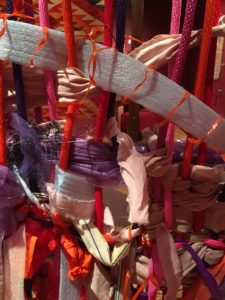
Close up of a finished section of a weaving in progress at the Columbus Museum of Art. Bright colors and a variety of materials

Advent gospels speak of God already come. They tell not only the story of John the Baptist and how Jesus was born into our world through the faith and willingness of a young Jewish girl.  They also tell of his public ministry, proclaiming God’s kingdom with words and actions. He healed the sick, confronted those in positons of power, and showed compassion for the poor and struggling. When asked what was most important, he replied it was love—love of God, self, and neighbor.

Jesus was open to surprise, amazed at the deep faith coming not from the Israelites, but from “the other”—a centurion. Echoing Isaiah, Jesus told his followers that they’d be sharing the heavenly banquet with people they mightn’t have expected, coming from east and west.

He relied on others to share in his work. When the huge crowd that had been listening to him for days needed to be fed, Jesus asked first that those present share what they had. Then he blessed it. Before sending his disciples out to spread the good news, he lamented that there was much work to be done and few to do it.

Yes, God is already here, and has been since before time as we know it began. Yet, “God is coming.” The events in our world, far from echoing the visions of Isaiah or the example of Jesus, speak of the need for this coming. The poor and vulnerable, so close to Jesus’ heart, are still abused and overlooked by those grasping for power and wealth. Nations continue to prepare for and to wage war. We are far from beating swords into plowshares.

Jesus knew that being faithful to the commandment of love can bring suffering and death in a world unwilling to accept it. After his death and resurrection, he sent the Spirit who dwells within each of us and in every bit of creation. We are part of the “both/and,” the coming” and the “already here.”

How do we live in the tension of this mystery? How do we join in God’s work today? How do we live in dark times and still have both faith in God-with-us and hope in God- to-come? Perhaps, during Advent we can take quiet time to listen for the Spirit that lives in our hearts. To become aware of our part giving birth to that bit of divinity that has been shared with us and that the world sorely needs. We are not only graced with the Presence of God with us, we are called to do our part in birthing the God who is yet to come.

© 2017 Mary van Balen


Thankful for the Gift of Presence

Thankful for the Gift of Presence

Originally published in The Catholic Times November 12, 2017

November 9 is the feast of the dedication of the Lateran Basilica in Rome, the official church of the Pope. The Mass readings for that day, not surprisingly, have to do with temples of one sort or another. The first reading is from Ezekiel 47, but let’s start a bit earlier in the book.

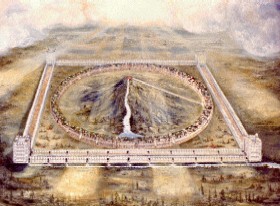
Rendering of Ezekiel's temple by Henery Sulley (1845-1940)

Ezekiel’s temple by Henery Sulley (1845-1940) Public Domain

In chapters 40-48 of Ezekiel, the prophet describes a vision where God transports him to a high mountain in Israel, and an angel gives him a tour of a new city. The vision is long and full of details: precise measurements of walls, inner courts, outer courts, door jambs, and Temple outbuildings, as well as the new Temple itself. Ezekiel witnesses the glory of God returning to fill the Temple, and God tells him that it again will be the Divine dwelling place in the midst of the people.

In addition to seeing the physical structures, Ezekiel learns the rules for those who serve in the Temple, how land is to be appropriated, how feasts are to be observed, and a list of protocols and procedures for Temple worship and sacrifices and that would make a Royal event planner’s head spin.

As I read these verses, I was glad it was Ezekiel and not me who had been instructed to remember every detail so he could share them with the exiled Israelites when he returned to them in Babylon. They had pretty much lost hope. Jerusalem had fallen, and despite the prophet’s valiant efforts to help them recognize that its destruction was imminent, many had clung to the illusion that Jerusalem would survive and they would go back home, resuming life as usual. I can identify. It’s a human tendency to ignore signs that portend the coming of something calamitous or the slow creep of something bad.

PHOTO: Mary van Balen

Next comes the description of the spring in the Temple. That’s the first reading for November 9. It’s abbreviated in the lectionary (To get the full effect, I suggest reading all the first twelve verses.), but it’s still a magnificent image.  A stream begins in the Temple, runs under the threshold, and flows to the Dead sea, swelling into a river too deep for anyone to cross.

When it reaches the sea, it makes the salt water fresh, teeming with all kinds of fish and water creatures. People flock there with nets. Wherever the river flows, it brings life and healing. Trees along its bank produce new, delicious fruit every month. Even their leaves are medicinal.  All this because it is God’s life flowing from the sanctuary.

When I read these words, I wanted to jump in! I wanted to splash through the river and sink beneath the water, let it do its healing, and then burst up through the surface full of hope, energy, and joy, free of the worries and concerns that fill my heart. Perhaps that’s how the Israelites felt when they listened to Ezekiel recount the story.

The good news is that God doesn’t dwell in temples or churches. Paul writes to the Corinthians, and to us, that we are the temples of God. (1 Cor 3, 16-17) The Spirit lives in each of us, neighbor and stranger alike. The glorious, healing, life-giving Presence that Ezekiel sees coming from the Temple, flows in and through all, gracing the people and places it touches. We don’t have to look for that river streaming down from the city on a hill; that “river” is everywhere. We can sink into Holy Presence wherever we are. Incarnation means God has entered into the matter of creation. We are immersed in that Presence whether we realize it or not. Open to it, Grace transforms us and all it touches. We can move into our deepest center and meet God there.

God is truly with us: strength in our struggles, joy in our celebrations, hope when we are tempted to despair. God walks with us when we are afraid, offers rest when we have worn ourselves out, waits when we are too busy to notice, fills what is empty, mourns with us in our grief, and sits with us when we don’t know what else to do.

The last words in Ezekiel, naming the new city, sum up this wondrous reality: “The name of the City shall henceforth be ‘The Lord is here.’” (48, 35)

© 2017 Mary van Balen

Doing What We Have Learned

Doing What We Have Learned

Abstract painting of people of all colors embracing

Painting by Richard Duarte Brown

Originally published in The Catholic Times  Oct. 8, 2017

Perhaps it’s because I’m weary of the divisive speech that is becoming more commonplace in our country and of the racism and ignorance of the “other” that undergird it. Maybe it’s hearing hateful comments, seeing intolerance, and recognizing that choices are being made to stoke fear and anger rather that to encourage true listening and dialogue. It’s these things and more that make me read and reread Paul’s words this Sunday, healing, like balm on an open sore:

Finally, brothers and sisters, whatever is true, whatever is honorable, whatever is just, whatever is pure, whatever is lovely, whatever is gracious, if there is any excellence and if there is anything worthy of praise, think about these things. (Philippians 4, 8)

A friend at work gave me a flyer about a unity celebration being held at a local Episcopal church that Sunday evening. I’m glad I went. It was something gracious and lovely that reminded me of the many good people who, in ways large and small, are being love in the world.

A woman opened the celebration with a drum call to gather everyone, including the ancestors. I thought of my parents. Of people who have gone before, working for civil rights. I thought of the communion of saints.

The rector welcomed us and read “Blessing When the World is Ending” by Jan Richardson. It finishes on a hopeful note:

This blessing/will not fix you,/will not mend you,/ will not give you/false comfort;/it will not talk to you/about one door opening/when another one closes./ It will simply/sit beside you/among the shards/and gently turn your face/toward the direction/from which the light/will come,/gathering itself/about you/as the world begins/again.

A young Syrian refugee, 13 when she arrived speaking no English, 17 now, shared her powerful poetry. A woman pastor reminded us that while we look different on the outside, we are the same on the inside and pointed out the fact that human beings are made with two ears and one tongue, perhaps indicating we should listen more and talk less.

PHOTO: Mary van Balen

Two young women in flowing white dresses gracefully danced their prayer to the One we can’t live without, expressing with their movements the prayer in my heart. An Imam spoke of Islam and respect for all prophets. We listened and learned.

A folksinger led us in “We shall not be moved,” a song loosely based on verses from Jerimiah about one who is like a tree firmly planted by the water surviving drought and yielding fruit. A young girl called out that we should sing for peace. And we did.

A Jewish rabbi considered that we have many names the for same Holy One. She spoke of the prophets of old and wondered about today’s prophets. About being prophets and being bold.

A soloist shook the rafters and sang about God breathing on us, and I felt the Spirit-breath.

A community organizer pulled wisdom from each presentation and put them into questions for us to ponder.

Afterwards, we shared food, listened to stories, and wondered why all churches don’t have evenings like this.

Paul’s final words in that verse from Philippians—Keep on doing what you have learned and received and heard and seen in me. Then the God of peace will be with you—prompted me to consider that what we learn from Paul, he learned from Jesus. What have I learned and heard and seen in Jesus that transforms me?

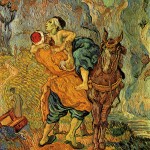
painting: The Good van Gogh Samaritan, by Vincent

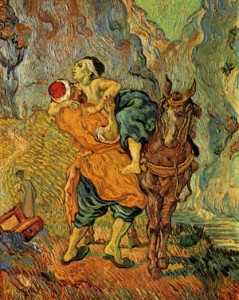
The Good Samaritan by Vincent van Gogh

In the gospels, I have learned that love, not power, is important. That one’s life doesn’t consist of possessions. That everyone is my neighbor, and I must take care of them. I have seen Jesus heal the sick, feed the hungry, hang out with those on the margins, and eat with outcasts. He was welcoming, patient, and merciful. He was a man of prayer. On his last night on earth he prayed “…that they may be one as we are one—I in them and you in me…” I watched Jesus wash his disciples’ feet and instruct them to do the same. He spoke truth to power, faithfully lived that truth, and was murdered for it.

I heard him say that whatever we do to the least among us, we do to him. And when it came right down to it, when someone asked him what was most important, he had two things to say: Love God. Love your neighbor as yourself.
These are the things we need to keep on doing, each of us bringing the God of peace who dwells in us into our times and places. Through all people of peace, God transforms the world.

© 2017 Mary van Balen

Saint Bonifacia’s Ordinary Way

Saint Bonifacia’s Ordinary Way

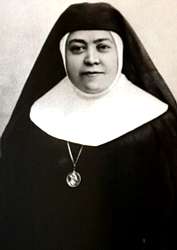
a photo of Saint Bonifacia Rodriguez y Castro S.S.J.Originally published in The Catholic Times Aug. 13, 2017
This week’s liturgical calendar celebrates the lives of three women saints: St. Teresa Benedicta of the Cross (Edith Stein), St. Clare, and Saint Bonifacia Rodriguez y Castro. If you’re like me, you’re familiar with the first two. But who was the third, Saint Bonifacia?

Her memorial is listed as August 7, 8, or 9th, depending on where you look, but a little research provided an inspiring portrait of the woman. Bonifacia was born in 1837, the oldest of six children, to a poor couple in Salamanca, Spain. Her father was a tailor who worked in his shop at home. Bonifacia learned not only his craft, but she and her siblings also witnessed the deep faith of both parents, lived simply in their home and community.

Her father died when she was fifteen, and Bonifacia began working for others outside her home. Eventually, she set up a shop in the family home, making and selling cords, lace, and other trimmings to support herself and her mother. Inspired by the quiet life of Mary, Joseph, and Jesus, she saw her home and shop as a little Nazareth where work and prayer were intertwined. Along with her mother, Bonifacia made daily visits to a nearby Jesuit-run church.

Other young women, attracted to her and her way of life, began to gather at her home on Sunday’s and feast days, finding a safe place to gather and support one another with prayer and Scripture, listening and encouraging as women do. The house-shop became a safe haven for women to work and pray.

Though Bonifacia longed to become a Dominican, the Jesuit priest at her church, Francisco Javier Butiña y Hospital (her spiritual director), had another idea. His deep concern for the plight of post Industrial Revolution factory workers and respect for the path to holiness through ordinary work resonated with Bonifacia. He suggested that together they establish a congregation to protect the women workers and promote a spirituality that embraced manual work as a way to holiness, not an impediment. The congregation became known as the Servants of Saint Joseph.

This was a new form for a women’s congregation, and while supported by some and by the local bishop at the time of its foundation, it later met with resistance from those more comfortable with women in convents. Like many before her, she suffered for her vision and determination to remain faithful to it.

As Saint John Paul II said in his homily at her beatification, “It was a form of religious life too daring not to have opposition. Immediately it was attacked by the then traditional diocesan clergy of Salamanca who does not grasp the evangelical depth of this form of life which is very close to the world of work.”

While this column doesn’t provide space to tell all her story, I can emphasize the importance her life and vision have for us today. Despite Vatican II’s insistence that the call to holiness is given to everyone and is found in all walks of life, many church faithful, clergy and lay alike, still think the path to sanctity is somehow separate from ordinary life. Holiness is seen best pursued in convents, monasteries, or rectories. Or at least in occupations connected with church or overtly religious activities.

Bonifacia knew better. Through prayer and reflection, she recognized God’s call deep within and trusted it, remaining faithful when others opposed and mistreated her. It’s easy to doubt the word that God speaks in our hearts, the call that directs us to bring God into the world in a way uniquely given to each of us, right where we are.

Bonifacia also knew that we don’t walk the path to God alone. We walk together. As she said, “We should be all for all, following Jesus.”  But trusting God’s indwelling in the “other” is a challenge, especially if the “other” looks different than we do, speaks a different language, or has views different than our own. Despite its difficulty, this ordinary path transforms the world by our taking God’s Presence into it.

The world needs people committed to this simple way of prayer and bringing God we come to know within into the streets and workplaces. Not by heavy handed evangelizing and dogma, but by living with love and joy, responding to the needs of those we encounter. By truly listening to “others,” open to recognize and receive God who dwells in their hearts. And like Bonifacia, by having courage to speak our truth to power. To do something different in familiar places.

©2017 Mary van Balen

Rain—An Icon of Grace

Rain—An Icon of Grace

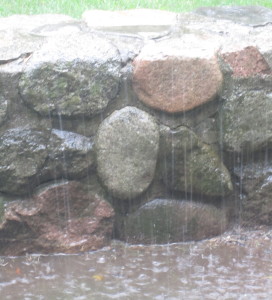
A photo of rain falling on a stone wall

PHOTO: Mary van Balen

Originally published in The Catholic Times, May 14, 2017

Rain pelted the windows as I fell asleep one Friday night this spring. Thunder rumbled in the distance, occasionally exploding through the thick sky, rattling the window beside my bed. I’ve always loved thunder storms, especially at night when I have nothing else to do but listen and watch for lightning flashes that brighten the darkness for a moment or two.

When I awoke late the following morning, rain was still falling, and heavy clouds shuttered the sky making the house dark enough that I lit a candle for prayer time. Rain drops became my centering “word” as I tried to quiet my mind and simply sit with God. That’s never easy. Managing a minute or two out of twenty without thoughts crashing around in my head is a success. I trust the Holy One appreciates the effort.

But that Saturday morning, rain made a difference. After a while it became an icon of Grace, falling steadily on the world, replenishing Life’s Gift that flows through all creation. I sat for a long time, moving in and out of quiet, trying to be present enough that some of that Gift could find a place in me.

The image of Grace raining down on the world stayed with me all day. I remembered times of exhilaration, running out in a downpour, getting soaked, and tilting my head up towards the sky with my mouth open trying to taste the drops. I also remembered making mad dashes from car to door, trying to avoid rain altogether.

Saturday came and went, but as the new week moved along, the image raised questions. How eagerly do I embrace Grace given. Do I stand with arms outstretched and heart open? Do I let it drench me? Do I stop and listen, no matter where I am or what I’m doing? Do I welcome it in and let it flow out? Or am I too busy, too distracted by noise to hear?

If so, the morning rain said not to worry. Grace is always falling.

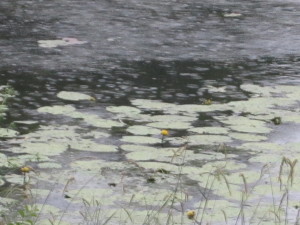
Photo of a heavy rain falling on waterlilies on lake at St. Johns

PHOTO: Mary van Balen

I remembered a few favorite scripture verses that speak about rain and God’s provident care:

For just as from the heavens/ the rain and snow come down/ And do not return there/ till they have watered the earth, /making it fertile and fruitful, /Given seed to those who sow/ and bread to those who eat, / so shall my word be/ that goes forth from my mouth;/ It shall not return to me void, /but shall do my will, /achieving the end for which I sent it.  Is 55, 10-11

These words bring hope that God’s Spirit, falling into my deepest places, flows through me as I go about my days, helping me do the work, knowingly or not, that I am made to do.

Sing to the Lord with thanksgiving; / with the lyre make music to our God, /Who covers the heavens with clouds, / provides rain for the earth, / makes grass sprout on the mountains… Ps 147, 7-8

 How important to nurture a grateful spirit, to give thanks for the outpouring of Grace that never stops, recognized or not.

Let us know, let us strive to know the Lord; /whose coming is as certain as the dawn, /and whose judgement shines forth like the light of day! /The Lord will come to us like the rain/like spring rain that waters the earth. Hosea 6, 3

 Trusting that God’s coming “is as certain as the dawn” is difficult when the earth of our hearts is parched or when suffering and injustice in the world overwhelms. Concerns of the heart can tempt it to close in upon itself, to keep Grace running down the outside instead of pouring in.

I have a photo of a rainy afternoon outside the apartment I stayed in one summer during a writing workshop in Minnesota. I think I’ll make a print of it and keep close by—an icon of never-ending Grace and Presence.

©2017 Mary van Balen

Columbus Crossing Borders Project

Columbus Crossing Borders Project

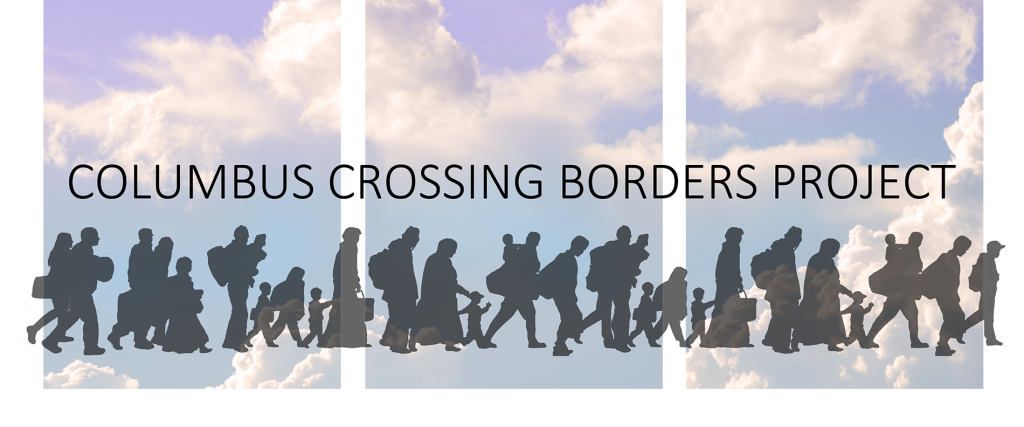
the logo for the Columbus Crossing Borders Project shows silhouettes of immigrants, men, women, and children, against a blue clouded sky. The Columbus Crossing Borders Project was begun by Columbus area artist, Laurie Van Balen, in response to the alarming spread of anti-immigrant sentiment that is sweeping the country. Visit the website to learn more about the artists, traveling art exhibit, and documentary film that is the result of 34 artists, refugees willing to share their stories,  a film crew, and many volunteers.

You can watch parts of the video made by Doug Swift,  meet some of the artists, see their work, and hear some of the refugees’ stories. This project aims to inspire compassion and encourage critical thinking when considering the plight of refugees in our country.

Columbus Crossing Borders Project is working with the Community Immigration and Refugee Services (CRIS) in Columbus.

Currently in production, the traveling art exhibit will open on May 21, at the Cultural Arts Center in Columbus. You are welcome to attend the opening reception:

“As we seek to inspire compassion and support for the 65 million people in our world who are fleeing war, terror, persecution and hardship, The Columbus Crossing Borders Project warmly invites you to attend the initial public presentation of our traveling art exhibit and documentary film.

Sunday, May 21  2 – 6pm    Cultural Arts Center  |  139 W Main St, Columbus, Ohio 43215

This event is being presented with support from the​ Greater Columbus Arts Council.”

I hope to see you there!

The Call to Love, Right Where We Are

The Call to Love, Right Where We Are

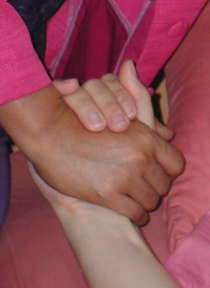
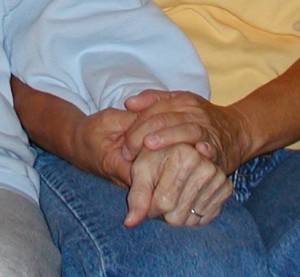
Rita and Mom's hands

PHOTO: Mary van Balen

Originally published in The Catholic Times, January 7, 2017

I spent a nice, low-key last day of 2016. Ran a few errands. Mailed two packages. Share a leisurely lunch with a good friend who came back to my place for a few last Christmas cookies and conversation. As I write and wait for midnight, I hear one of my daughters and friend laughing in the living room, here for a few hours before heading out to a party. A nice, homey, New Year’s Eve.

I admit to looking forward to 2017 with some trepidation, more aware than usual of the uncertainties we face at home and around the world. The issues are not new, but carry an increased sense of urgency: civil rights, immigration, poverty, global warming, terrorism, war.

Over the holidays, a friend shared with me the trauma she is experiencing after returning from working on a documentary in the Holy Land. While she heard lots of talk of Bethlehem as Christmas approached, and the strains of “O Little Town of Bethlehem” filled the air, she was overcome by the suffering she witnessed in the modern occupied city of Bethlehem.

“Both Palestinians and Jewish Israelis, say, ‘There is no such thing as Post Traumatic Stress Disorder here because there is no Post, just traumatic stress disorder’,” she said.

Her experience of one small part of the world speaks to the fear and uncertainty of so many in the global “neighborhood.”

How do we move forward into this new year? As followers of the Christ, how do we bring the love and peace of God’s kingdom into the world? How do we live with hope?

Yesterday, I read the next-to-the-last-last chapter of the Rule of Saint Benedict which spoke of the “good zeal” of monastics: to show respect for the other, to seek what is better for others, to support one another, and to show patience and love. Above all, to love God.

In the face of great challenges, loving those we live with and encounter in our daily lives seems trivial. What difference can such small actions make?

In commentary following the passage from the Rule, Benedictine Joan Chittister speaks to Benedict’s insistence on listening for God’s voice in one another and in the present moment. She recounts a wisdom story from another tradition: A seeker asks the teacher how to reach Enlightenment. The answer is deceptively simple: No special time or place is required. No special way of listening or unique places to look. Being present to the moment, to the people around you, to the place where you are is what is needed. Enlightenment happens there.

painting: The Good van Gogh Samaritan, by Vincent

The Good Samaritan by Vincent van Gogh

Jesus in the gospels tells his followers that the Kingdom of God is now, in the moment, as well as coming. He said whatever we do for the least among us, we do for him. He invited us to live as he lived, present in the moment to his relationship with God and with neighbor. And Jesus’ parable of the Good Samaritan, clearly shows who that neighbor is—everyone.

Why is hearing God’s voice and experiencing God in the moment and in others so difficult? Why is “Practicing the Presence of God,” as the 17th century Carmelite, Brother Lawrence taught, such a challenge? Reading his work of the same title, we realize being truly present to God in ordinary life is a human struggle, not unique to our time.

The temptation is to imagine, like the seeker in Joan’s story, that God is found in extraordinary places. That to participate in transforming the world with Divine Love requires dramatic action, and that only a few exceptionally “holy ones” are called to do so.

As we enter 2017, the temptation is to be overwhelmed and think our lives too small, our actions too insignificant to make a difference. Jesus tells us “not so.” The temptation is to look to others, more powerful, more “important” to do the work. Jesus turns that upside down, too. He called poor fisherman, women, and people on the fringes of society ordinary people, not the religious or political big-wigs of his day to bring Love into the world.

And Jesus assured us that we don’t act alone. Joined with the Source of all that is, our acts of love are part of the Divine Act of Love that confronts darkness and is not overcome. Here is the hope we carry into the new year. Be present. Be aware of God-with-us right where we are. And trust in the power of the Love that flows through us to transform the world.

© 2017 Mary van Balen

Drawing All into the Circle of Love

Drawing All into the Circle of Love

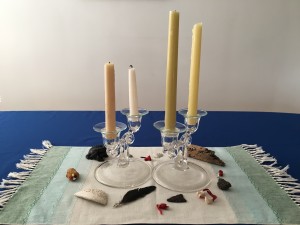
Advent wreath with taper and glass candelabra surroounded by shells, arrowhead, driftwood, and a feather.

PHOTO: Mary van Balen


Originally published in The Catholic Times  December 11,2016

After a lovely and unusual Thanksgiving weekend spent with my two sisters and their husbands, I was caught unawares by Advent. Oh, in a vague sort of way I knew it was coming, but I was busy with work, publishing a book, and cleaning the house for my company.

When they left on Saturday afternoon, I ran errands and fell asleep, stretched out on the couch. Then suddenly it was Sunday, and I had not prepared a wreath. Resisting the urge to run out and buy candles, I decided to use what was already around the house.

Over the years, my wreath has evolved into something decidedly untraditional. Forty years ago, inspired by Black Elk (a Lakota holy man who, I later learned, became a Catholic catechist), I sewed and beaded four tiny red leather pouches filled with a mixture of sage and sweet grass symbolic of kinnikinnick used by some Native Americans in their great peace pipes and in other rituals.

The pouches rested on four direction points of the wreath: North, East, South, and West. A feather, shells, and a small buffalo cut from leather also decorated the pine boughs, a reminder that God is the Creator of all things, and that all things are made holy by the Incarnation.

Eventually, allergies and bronchitis set off by aromatic resin and the mold that clung to the freshly cut pine necessitated its removal. I thought about artificial greenery but decided against it.

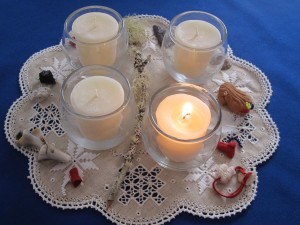
four vigil candles arranged on linen surrounded by tiny read leather pouches, feeather, shell, and other items for Advent wreathit

PHOTO: Mary van Balen

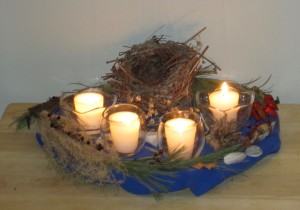
Instead, I used beeswax vigil candles arranged on a round linen doily or tray covered with a deep blue napkin. The little pouches, feather, shells, and buffalo remained. A stone from the shores of the Sea of Galilee, gift of a friend, became a regular addition. Once I added a bird’s nest and soft, dried pampas grass plumes. Everything belongs in this circle. We stand on holy ground.

This year, I found tucked in a drawer some beeswax candles from Burton Parish, the colonial Episcopalian church in Williamsburg, VA. The tapers would just fit into the two simple glass candelabra that my parents had used to decorate the table at their wedding reception.

I washed and dried the candle holders, remembering an old photo of my parents, their families, and friends gathered around a long table in Dad’s family home for the celebration. The candelabra would gather my family and the human family into the circle of my “wreath.”

Along with the usual items, a wooden frog from Thailand, a fossil scallop picked up along the York River under Super Moon’s shine, a smooth piece of chert from a Paris walkway, and an arrowhead found on a Cape Cod beach joined the circle.

All the earth sits with me as I light the candles and remember the mystery of Jesus walking with us. Each night my parents and ancestors sit with me as do the people who were here first and who struggle still to protect the land and water that sustain us all. I am reminded of the ages and ages of this earth, of the creatures that filled it. The plants and animals, the birds and the sea creatures. We are a small part of an unimaginably huge cosmos. God loves it all and entered into our little corner to show us just how much.

The words of Isaiah that appear throughout our Advent liturgies overflow with images of nature. Crooked paths made straight. Parched land exulting. Steppes rejoicing and blooming with abundant flowers. Enemies, the lion and the lamb, lying down together. An old stump that looks dead sprouts a green shoot. Things are not always what they appear to be.

Isaiah says God will not judge by appearance. God stands with the poor and stands for justice.

Glorious words.

Four beeswax vigil candles in glass holders, surrounded by birds nest and other natural objects used as an Advent wreath

PHOTO: Mary van Balen

I sit at my dining room table, looking at my “wreath” and longing for such a time. Advent tells me that time is already here. We celebrate Emanuel, God-with-us. Jesus draws the circle that encompasses all and invites us to join the work. He showed us how to live our lives, a part of God’s own, so the circle continues to grow in our time and place.

I sit at my dining room table, watching candle flames push away early morning darkness, and I have hope.

© 2016 Mary van Balen

Look at Me. Just Me.

Look at Me. Just Me.

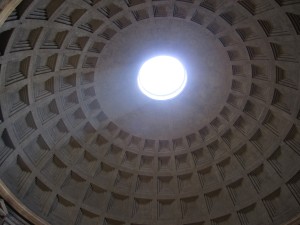
Dome of Pantheon, with light streaming in.

PHOTO: Mary van Balen
Dome of Pantheon, Rome, Italy.

Originally published in The Catholic Times August 14, 2016 issue

While preparing to write this column, I read through the Mass readings for the week as I often do. Actually, I had a topic in mind, but the Spirit had another tucked into Sunday’s second reading from the Letter to the Hebrews. “Brothers and sisters:” it begins, “Since we are surrounded by so great a cloud of witnesses, let us rid ourselves of every burden and sin that clings to us and persevere in running the race that lies before us while keeping our eyes fixed on Jesus, the leader and perfecter of faith.”

It was the phrase “keeping our eyes fixed on Jesus” that let me know clearly, this was the column. Here’s the back story. Last month, I sent an email to a good friend in Boston asking for prayers. We’d met during our first gathering for members of Shalem Institute’s Spiritual Guidance Program a couple of years ago and have stayed in touch ever since, continuing to share our journeys through letters, emails, and an occasional phone conversation.

When I wrote that email, life was feeling particularly overwhelming. Changes in family routine and a world where violence seemed more random and sinister than ever—though of course it’s always sinister and often random—were getting the best of me. My “worry gene” had kicked in, and I couldn’t quiet my mind or spirit for long. Falling asleep at night was difficult.

The email request for prayer wasn’t about this sense of turmoil, but as the Spirit would have it, my friend’s answer was.

It turned out he was on a challenging retreat. With the change of venue from a lovely new retreat house on the ocean (the building had fallen behind schedule and wasn’t ready) to a gloomy, old institutional building that once housed a seminary, and the discovery that the retreat was for spiritual directors giving the Ignatian Exercises (which he was not), the first few days were tough going.

He felt distant and agitated. Then, as he wrote: “I heard Christ telling me: ‘Look at me.  Just at me.’  Finally, last night, I was able to settle a bit in prayer.”

I couldn’t get those words out of my mind. “Look at me. Just at me.” That night, I tried to do that, to keep my focus on Christ. Not on events swirling around me and pulling me with them into dis-ease and anxiety. I fixed the gaze of my heart on Jesus. The one who loves. The one who holds. The one who is always “with.”

It wasn’t easy. Nagging fears and a sense that the world was somehow careening out of control kept calling for my attention. Not being sucked into the chaos required a conscious choice again and again, to heed Christ’s words: “Look at me.”

Slowly, that choice to look at Love made a difference. The grip of events that were tempting me with illusions of the ability control them loosened. Instead of imagining control, I felt moved to surrender to trust instead. Not a trust that everything was going to go as I wanted it to or that evil didn’t exist, but a trust that everything didn’t depend on me and my constant attempts to figure it out. The chatter that filled my head started to fade until finally there was blessed quiet. Churning and turmoil was being replaced by stillness and calm.

I slept well that night, and many nights after. Whenever I felt worry taking hold or fear seeping in to my center, I repeated the Christ’s injunction: “Look at me. Just at me,” and turned the eyes of my heart to Love.

So today, when I came across the admonition in Hebrews to embrace the wisdom of the “cloud of witnesses” and let go of burdens and sin that cling to us, to go forward and meet whatever is ahead while keeping our eyes on Jesus, I remembered my friend’s words that have become a powerful prayer for me.

It’s not magic. Sleep sometimes eludes. Deep openness is still gift. I wake up knowing I have work to do. Transforming the world is everyone’s work. But we don’t do it ourselves. We do it by letting Love fill us until we can bring that Holy Mystery to every place and every person we meet. Somehow, we face the evil and craziness and unknown with the steadiness of Love. I’m not sure how it works. It has something to do with being present. It has something to do with trust. It has everything to do with Love.

©2016 Mary van Balen