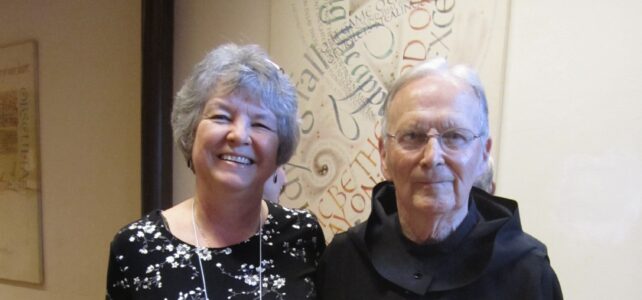
Morning sun poured through the slatted window shade, painting me and my gray recliner with stripes of light. A live-edged wooden table fashioned by my daughter sat beside me, holding a cup of tea and a few books, ready for my “greet the morning” ritual. Instead of reaching for Mary Oliver or Ted Kooser, I opened a book of poetry by my friend, Kilian McDonnell, who had died the day before. Kilian: Benedictine monk, theologian, author of scholarly books, professor, founder of the Collegeville Institute, poet, and my friend. He died on September 8 and would have been 104 on September 16, the day of his burial—a complete 104- year journey.
Unable to attend his funeral, I watched the livestream from St. John’s Abbey in Collegeville, Minnesota. At 104, he had outlived many of his family members and friends, but those who were able to travel gathered with the monks to give him a prayerful, loving sendoff.
Don Ottenhoff, former Executive Director of the Collegeville Institute, offered some words of remembrance. He told a story of arriving at the Institute for the first time in 2004 and seeing a portrait of its founder hanging on the wall in the Institute’s meeting place: a very serious Kilian reflecting his stature as a noted theologian and scholar. Later, in a storage closet, Don discovered a second portrait by the same artist: a playful, mischievous Kilian with a hint of a smile, reflecting another side of Kilian: the poet wrestling with God, Scripture and world through the lens of imagination. Don replaced the stern portrait with the smiling one. He and Kilian took turns replacing one portrait with another until Kilian relented and allowed the warmer, more approachable one to remain. It greeted me when I arrived at the Institute in 2008.
At the scholars’ first lunch together with Institute staff, I scanned the table, looking for a face that matched the portrait. Finding none, I wondered if Kilian were still alive. A monk slipped into the seat beside me and introduced himself. It was Kilian, going strong at 87. He welcomed me and helped me relax in the group of scholars and PhDs – I am neither – that I would be living and working with for the next nine months. Definitely the smiling Kilian.
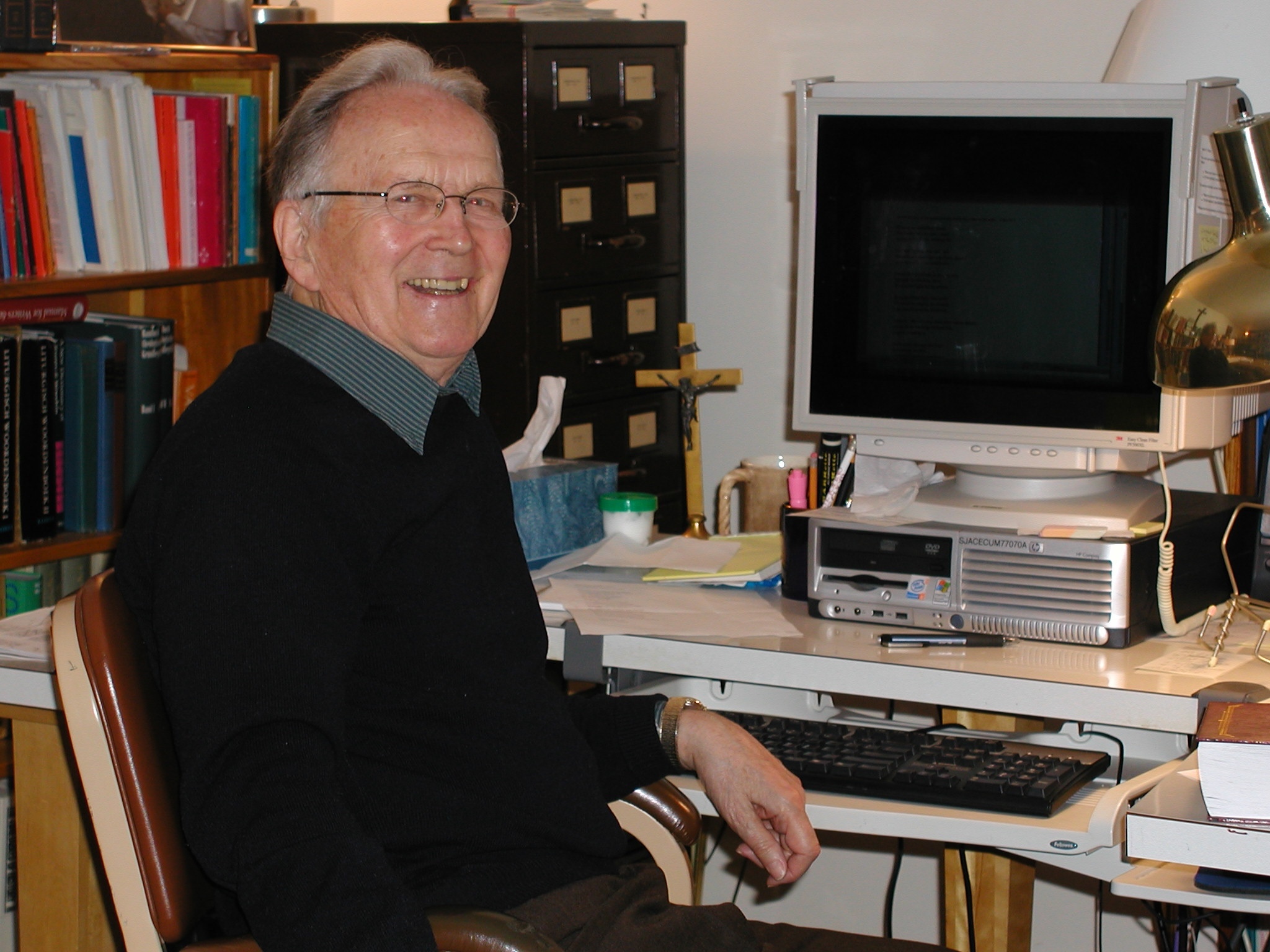
he His office was across the hall from mine in the library basement. When the noon prayer bell called, he stopped what he was doing and walked across a road and the small grassy patch it encircled to the abbey church. I often walked with him. Once he wondered aloud if monks, gathering every day to chant the same old Psalms year after year made sense anymore or if it made any difference in the world. I wasn’t sure about the world, but being part of that gathering day after day made a difference for me. It wasn’t always the words, though sometimes it was. It was the community, the cadence of the chant, ancient, like the rhythm of ocean waves. A restful balm washing over my tired soul.
Our friendship deepened over the months. One evening, struggling with the recent death of my mother, a crumbling marriage, and an exhausted spirit, I called. He came. We sat in my apartment and talked. I don’t remember what was said. What I do remember was his willingness to be present, to listen, and to share some of his journey.
Our conversations were not always so serious. Once I walked across the hall to his office and asked if he’d translate an article for me. Published in a Sardinian newspaper, it featured my daughter who works there as an archaeologist. He obliged then told me I should teach myself Italian. “Take Pimsleur language tapes out of the library,” he said. “I taught myself Italian at fifty-nine.” I told him I was there to write a book and he said, “Well, you can listen while you’re in the car.” When I responded that I didn’t drive much since I walked to the library, the church, and events around campus, he said I could listen while I worked in the kitchen or did other things around the apartment. I checked out the tapes but confess they mostly stayed in their case.
I did some driving of course, including taking us both to the St. Cloud cinema to enjoy the Met’s simulcast operas and good conversations as we circled around and around the lobby during intermissions.
Kilian and I stayed in touch after my year at the institute was over. I enjoyed the celebration of his 90th birthday along with his family, monastic community, colleagues and friends. At 90, he assured us he would be around when his next book of poetry was published. He was! I visited him at the Abbey a few more times and attended a weeklong workshop at the Institute in the years that followed. We called and exchanged cards and letters and writing projects now and then.
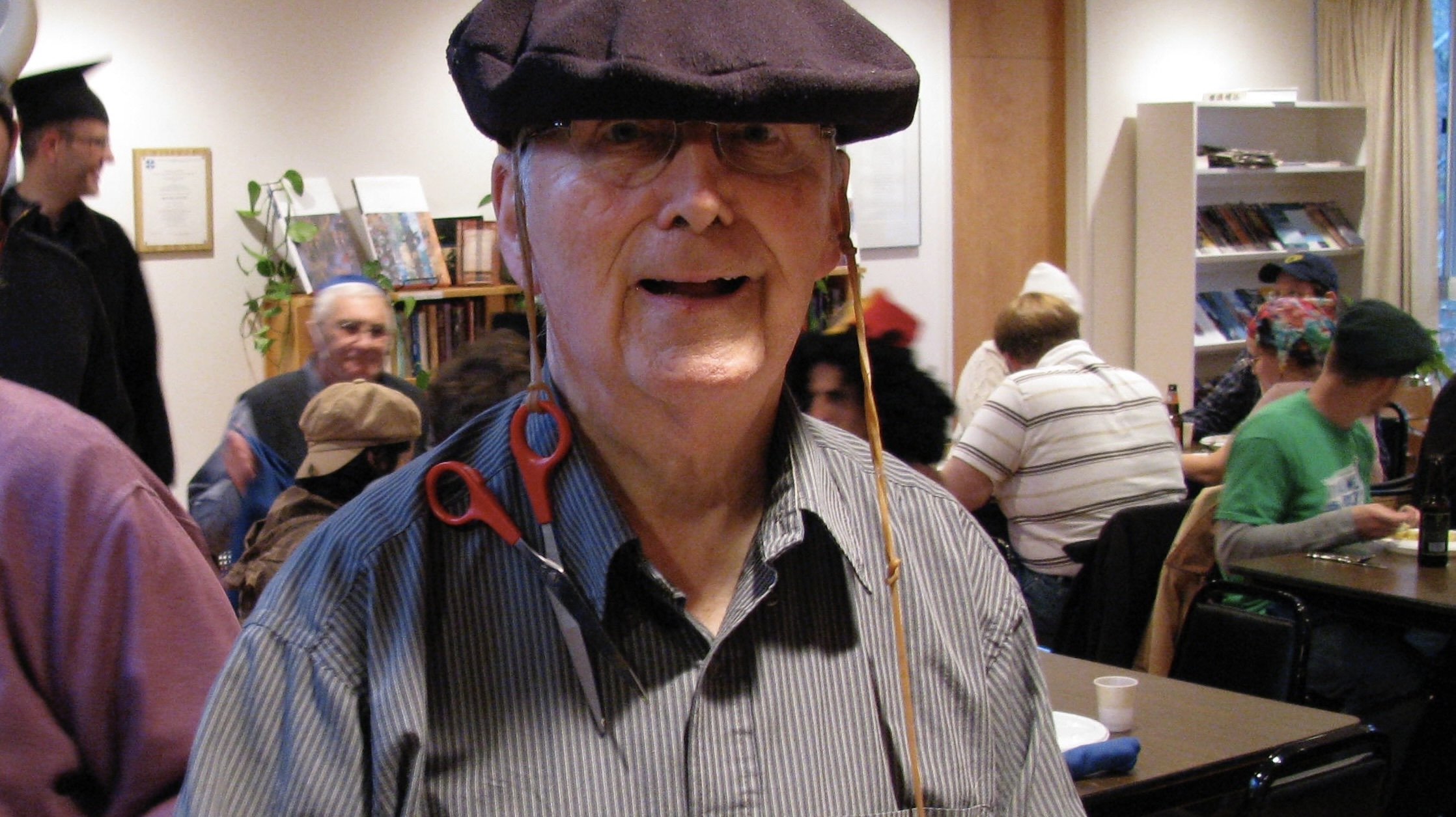
After hearing of his death, I looked through photos of my time at the Institute and subsequent visits to Collegeville. There was a fancy dress party one October. Everyone had to wear some kind of hat. Kilian came with a pair of scissors hanging from each side of his smart flat cap! He enjoyed a good laugh and the conviviality of lighthearted community gatherings—some planned, some spontaneous—embracing them as he embraced life’s more serious and difficult times.
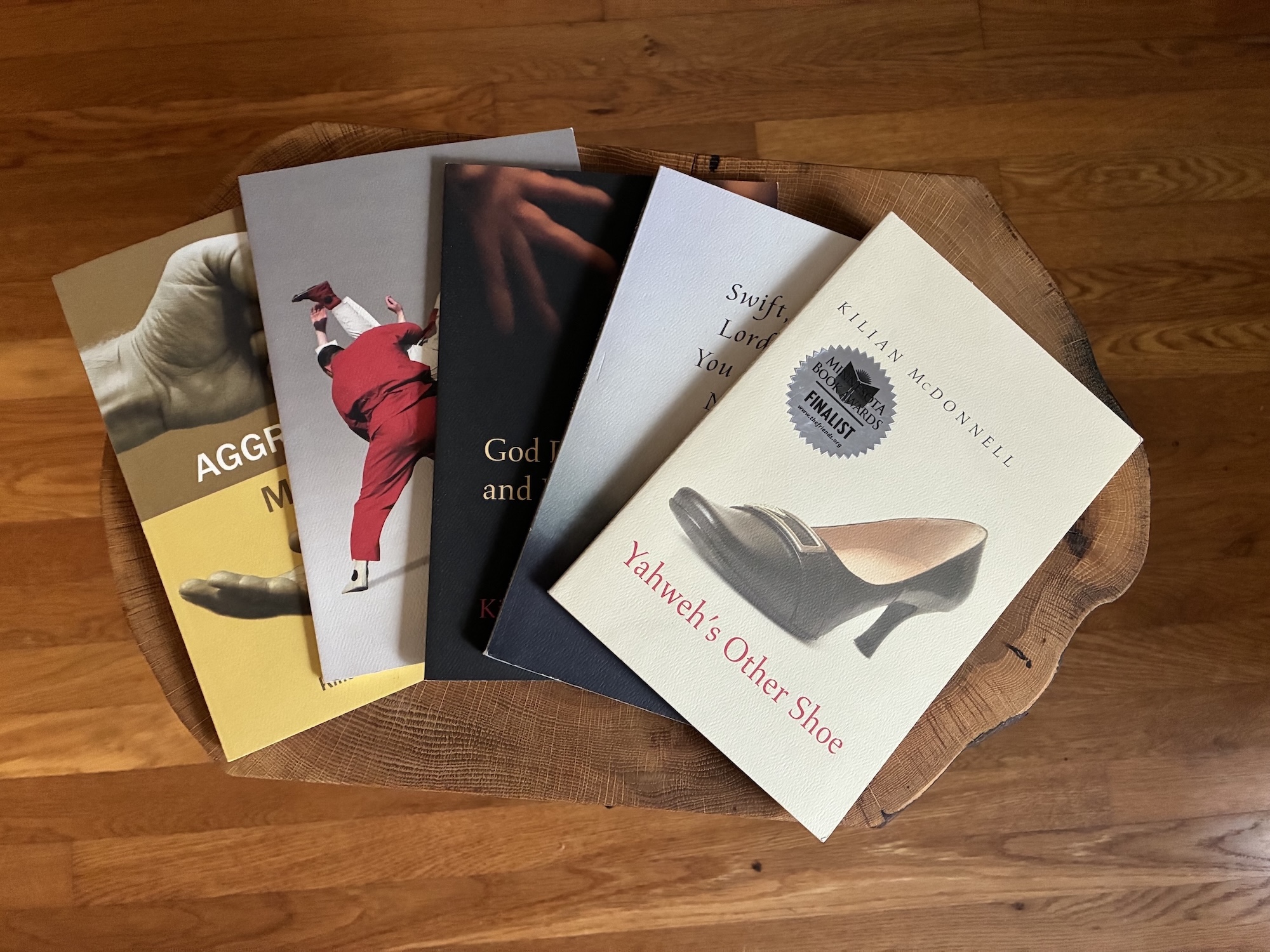
At seventy-five Kilian began his fruitful pursuit of poetry. He read and studied the masters. He had prize-winning poets as mentors and set aside hours for writing. By ninety-three he had published five volumes of poetry. (He liked to remind his readers that he did not write pious verse!) One volume, Yahweh’s Other Shoe, was a finalist for the Minnesota Book Award. His poem “The Monks of St. John File in for Prayer” is included in Garrison Keillor’s Good Poems for Hard Times. His poetry appeared in other places including Krista Tippett’s OnBeing and Keillor’s NPR segment, The Writer’s Almanac.
I turn seventy-five this month and often think of Kilian when I pull out watercolors and journals or toil over a picture book manuscript. Kilian’s voice emerges from the silence: “Mary, keep going. Do your work. You’re not too old.” And so I do.
Kilian was a Benedictine monk. A man of prayer and openness – to God and to all life offered. The unexpected. The joys. The sorrows. He embraced them as he could, and the Grace that came with them. Kilian’s life was full, and he shared it freely with the world. I am deeply grateful.
Resources
Kilian’s Poems in:
“Perfection Will Do You In” by Parker Palmer
On Being: The Monks of St. John’s File In for Prayer
Good Poems for Hard Times by Garrison Keillor
Collegeville Institute
Kilian was committed to ecumenical dialogue. In 1967 he founded The Collegeville Institute (Originally The Collegeville Institute for Ecumenical and Cultural Research). As stated on it’s website, its mission is to “…promote scholarship, leadership, creativity, & community among people of faith.” You can find more about the Institute and its many offerings starting on its homepage: Collegeville Institute