Celebrating My Monk Friend: Kilian McDonnell, OSB

Celebrating My Monk Friend: Kilian McDonnell, OSB

Morning sun poured through the slatted window shade, painting me and my gray recliner with stripes of light. A live-edged wooden table fashioned by my daughter sat beside me, holding a cup of tea and a few books, ready for my “greet the morning” ritual. Instead of reaching for Mary Oliver or Ted Kooser, I opened a book of poetry by my friend, Kilian McDonnell, who had died the day before. Kilian: Benedictine monk, theologian, author of scholarly books, professor, founder of the Collegeville Institute, poet, and my friend. He died on September 8 and would have been 104 on September 16, the day of his burial—a complete 104- year journey.

Unable to attend his funeral, I watched the livestream from St. John’s Abbey in Collegeville, Minnesota. At 104, he had outlived many of his family members and friends, but those who were able to travel gathered with the monks to give him a prayerful, loving sendoff.

Don Ottenhoff, former Executive Director of the Collegeville Institute, offered some words of remembrance. He told a story of arriving at the Institute for the first time in 2004 and seeing a portrait of its founder hanging on the wall in the Institute’s meeting place: a very serious Kilian reflecting his stature as a noted theologian and scholar. Later, in a storage closet, Don discovered a second portrait by the same artist: a playful, mischievous Kilian with a hint of a smile, reflecting another side of Kilian: the poet wrestling with God, Scripture and world through the lens of imagination. Don replaced the stern portrait with the smiling one. He and Kilian took turns replacing one portrait with another until Kilian relented and allowed the warmer, more approachable one to remain. It greeted me when I arrived at the Institute in 2008.

At the scholars’ first lunch together with Institute staff, I scanned the table, looking for a face that matched the portrait. Finding none, I wondered if Kilian were still alive. A monk slipped into the seat beside me and introduced himself. It was Kilian, going strong at 87. He welcomed me and helped me relax in the group of scholars and PhDs – I am neither – that I would be living and working with for the next nine months. Definitely the smiling Kilian.
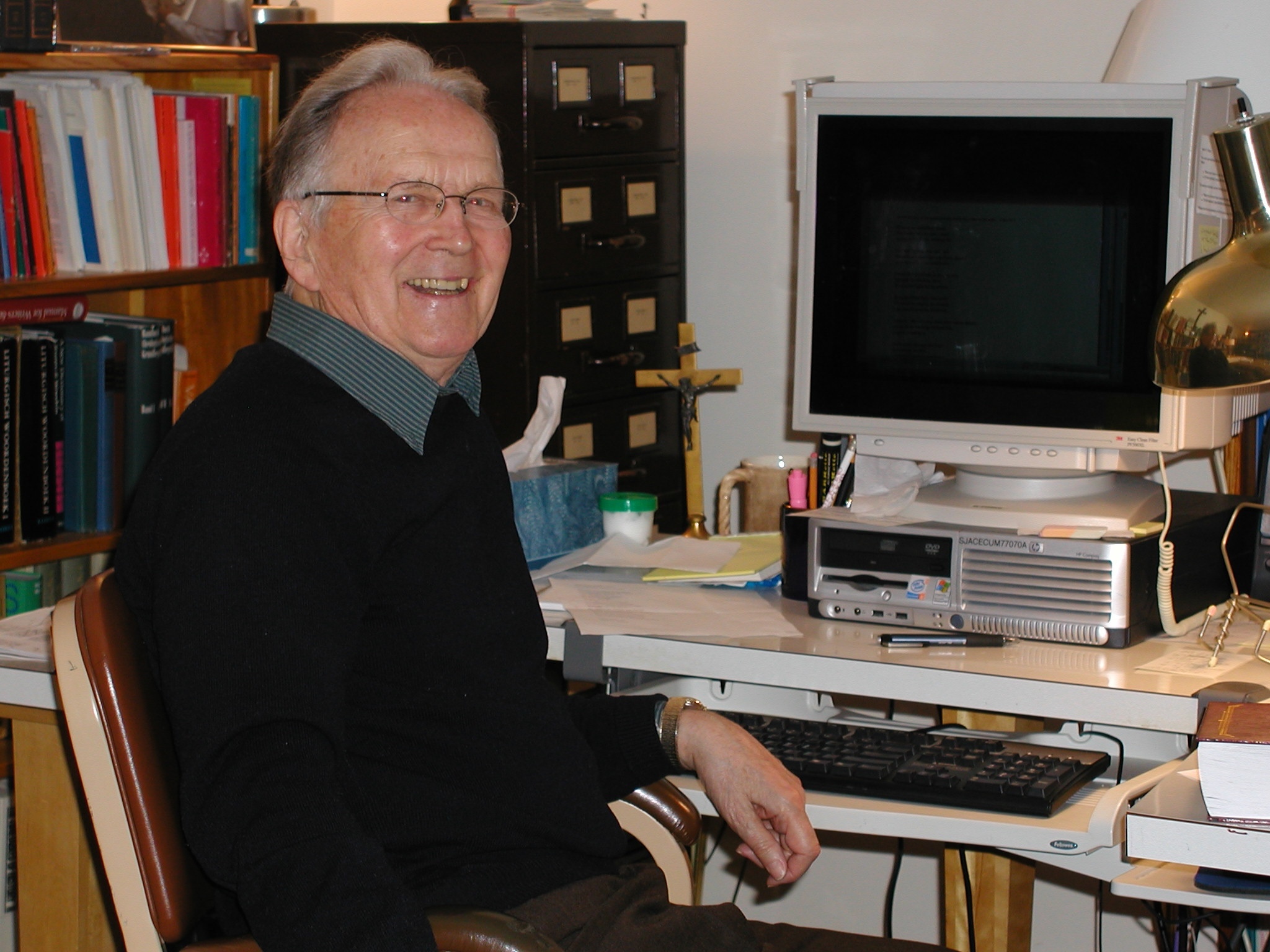
he His office was across the hall from mine in the library basement. When the noon prayer bell called, he stopped what he was doing and walked across a road and the small grassy patch it encircled to the abbey church. I often walked with him. Once he wondered aloud if monks, gathering every day to chant the same old Psalms year after year made sense anymore or if it made any difference in the world. I wasn’t sure about the world, but being part of that gathering day after day made a difference for me. It wasn’t always the words, though sometimes it was. It was the community, the cadence of the chant, ancient, like the rhythm of ocean waves. A restful balm washing over my tired soul.

Our friendship deepened over the months. One evening, struggling with the recent death of my mother, a crumbling marriage, and an exhausted spirit, I called. He came. We sat in my apartment and talked. I don’t remember what was said. What I do remember was his willingness to be present, to listen, and to share some of his journey.

Our conversations were not always so serious. Once I walked across the hall to his office and asked if he’d translate an article for me. Published in a Sardinian newspaper, it featured my daughter who works there as an archaeologist. He obliged then told me I should teach myself Italian. “Take Pimsleur language tapes out of the library,” he said. “I taught myself Italian at fifty-nine.” I told him I was there to write a book and he said, “Well, you can listen while you’re in the car.” When I responded that I didn’t drive much since I walked to the library, the church, and events around campus, he said I could listen while I worked in the kitchen or did other things around the apartment. I checked out the tapes but confess they mostly stayed in their case.

I did some driving of course, including taking us both to the St. Cloud cinema to enjoy the Met’s simulcast operas and good conversations as we circled around and around the lobby during intermissions.

Kilian and I stayed in touch after my year at the institute was over. I enjoyed the celebration of his 90th birthday along with his family, monastic community, colleagues and friends. At 90, he assured us he would be around when his next book of poetry was published. He was! I visited him at the Abbey a few more times and attended a weeklong workshop at the Institute in the years that followed. We called and exchanged cards and letters and writing projects now and then.

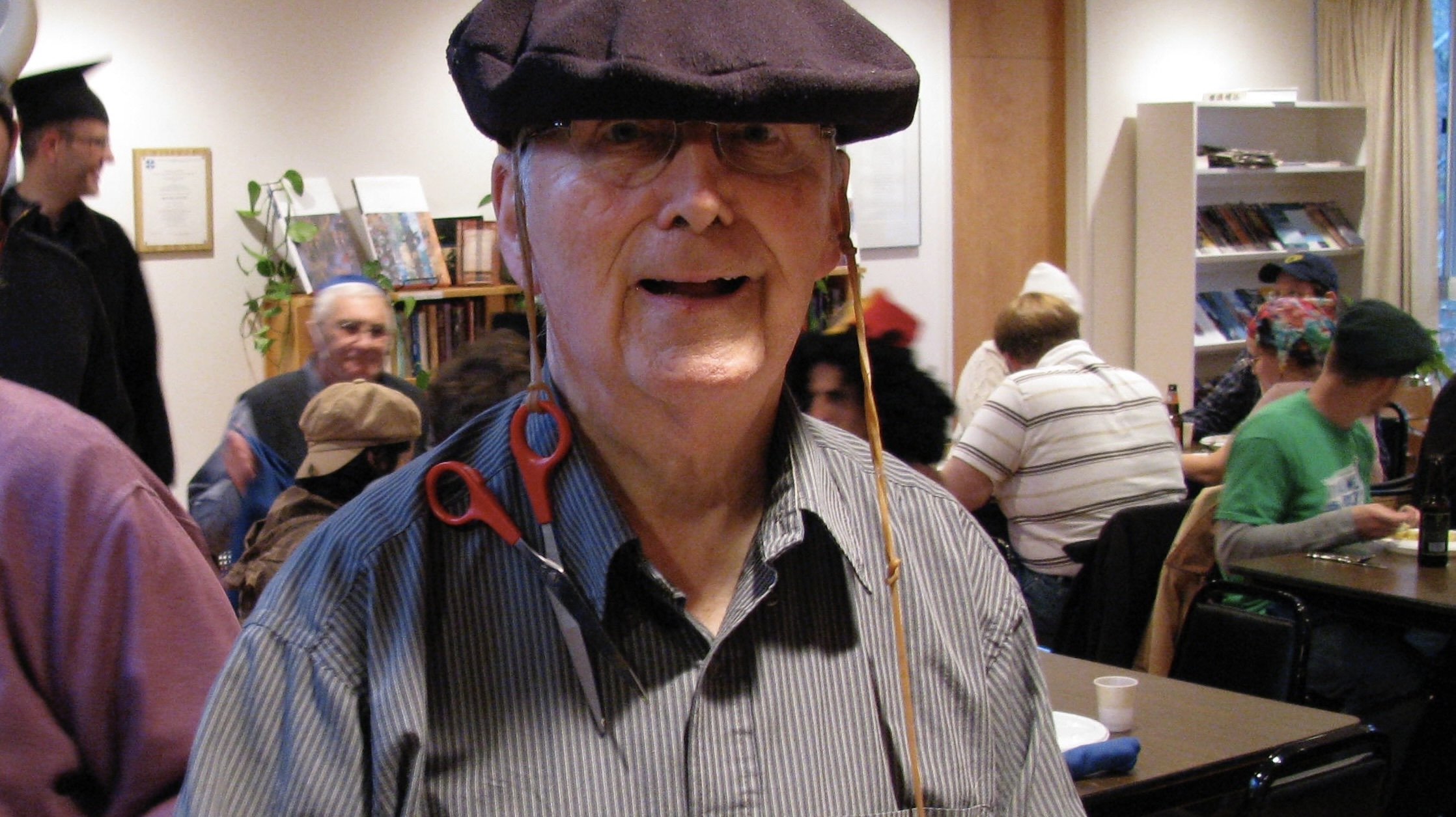
After hearing of his death, I looked through photos of my time at the Institute and subsequent visits to Collegeville. There was a fancy dress party one October. Everyone had to wear some kind of hat. Kilian came with a pair of scissors hanging from each side of his smart flat cap! He enjoyed a good laugh and the conviviality of lighthearted community gatherings—some planned, some spontaneous—embracing them as he embraced life’s more serious and difficult times.
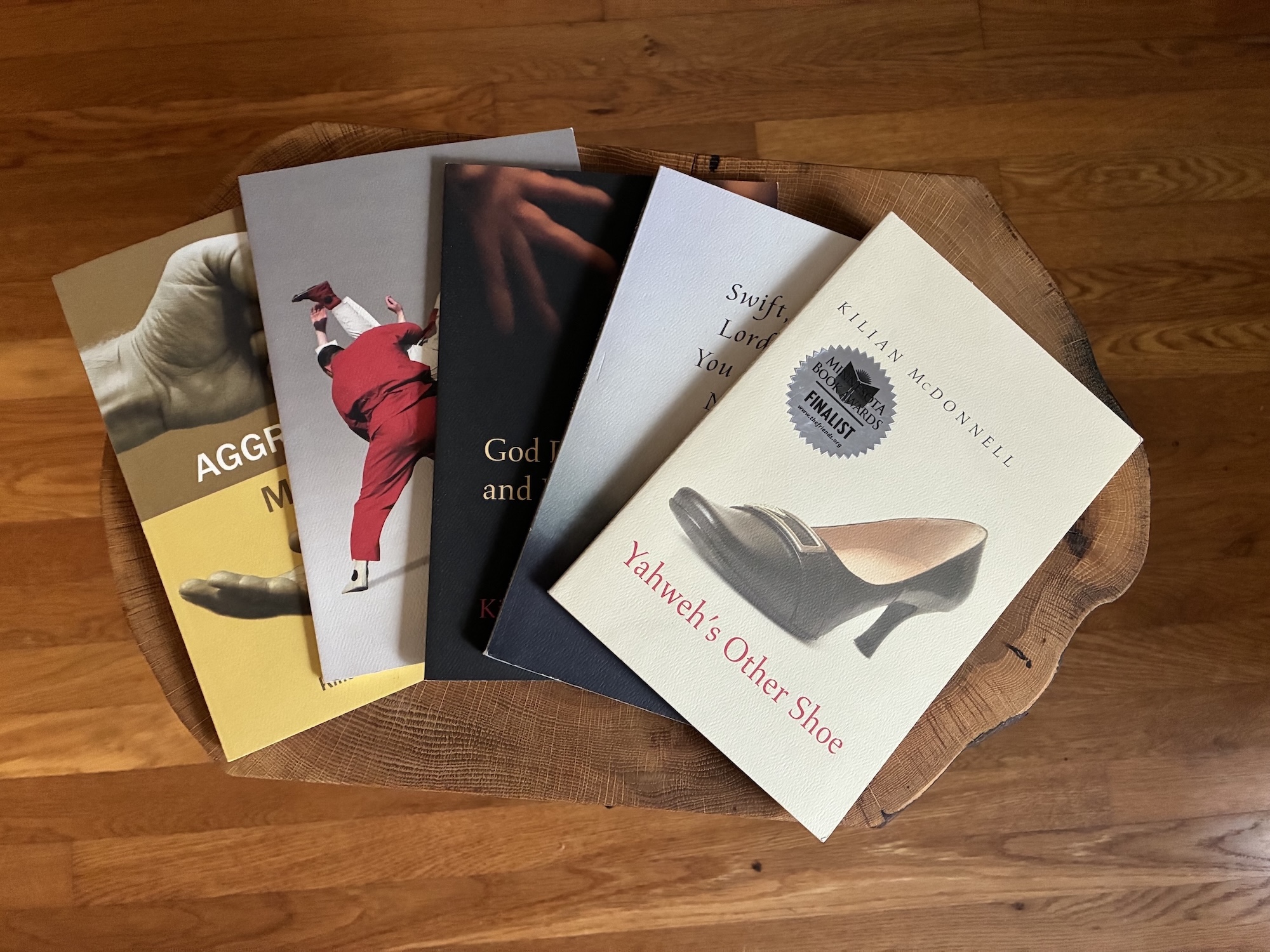
At seventy-five Kilian began his fruitful pursuit of poetry. He read and studied the masters. He had prize-winning poets as mentors and set aside hours for writing. By ninety-three he had published five volumes of poetry. (He liked to remind his readers that he did not write pious verse!) One volume, Yahweh’s Other Shoe, was a finalist for the Minnesota Book Award. His poem “The Monks of St. John File in for Prayer” is included in Garrison Keillor’s Good Poems for Hard Times. His poetry appeared in other places including Krista Tippett’s OnBeing and Keillor’s NPR segment, The Writer’s Almanac.
I turn seventy-five this month and often think of Kilian when I pull out watercolors and journals or toil over a picture book manuscript. Kilian’s voice emerges from the silence: “Mary, keep going. Do your work. You’re not too old.” And so I do.

Kilian was a Benedictine monk. A man of prayer and openness – to God and to all life offered. The unexpected. The joys. The sorrows. He embraced them as he could, and the Grace that came with them. Kilian’s life was full, and he shared it freely with the world. I am deeply grateful.

Resources

Kilian’s Poems in:

“Perfection Will Do You In” by Parker Palmer

On Being: The Monks of St. John’s File In for Prayer

Good Poems for Hard Times by Garrison Keillor

You can find all Kilian’s books of poetry—Swift Lord You Are Not, Yahweh’s Other Shoe, God Drops and Loses Things, Wrestling With God, Aggressive Mercy—at Bookshop.org

Collegeville Institute

Kilian was committed to ecumenical dialogue. In 1967 he founded The Collegeville Institute (Originally The Collegeville Institute for Ecumenical and Cultural Research). As stated on it’s website, its mission is to “…promote scholarship, leadership, creativity, & community among people of faith.” You can find more about the Institute and its many offerings starting on its homepage: Collegeville Institute

A Friend’s Gift

A Friend’s Gift

Deep friendships add light to one’s soul even in difficult and dark times. Those special people with whom we share our journey offer a safe place to rest, finding a space in their hearts for our struggles and sorrow as well as our dreams and joy. They celebrate with us. (Something I suggest we do as often as possible and for every little thing.) They accompany us as we grieve. As we process what life is handing us. Or ponder big questions along with the mundane: weather, books read, or what to cook for dinner. They share hard-won wisdom. No topic is taboo. These friends may cry with us or tap laughter hiding beneath our tears. They may simply “be with” us when there are no words to say or when neither of us can see a path opening ahead.

Such companions have blessed me. I hope the same for you. The pandemic may have complicated personal connections, but bonds with deep friends are resilient and remain. 

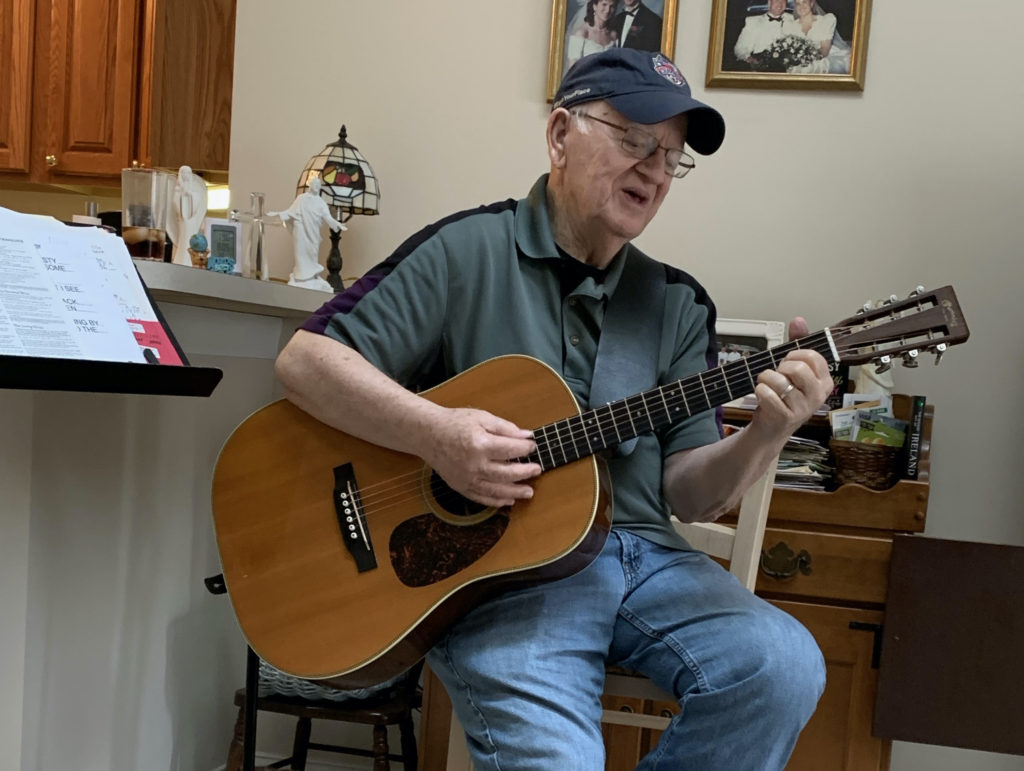
Mike was such a friend. He passed away in February of this year. Our final in-person visit was last year in late June. We shared lunch, and appropriately, guitar playing and song.

Mike Wood playing guitar and singing
Mike

Music and desire for community brought us together when I was around 17. A small group of people, most in their late 20s and early 30s, were gathering to explore their faith and how to live it out during the years that saw the Vietnam war, the growing civil rights movement, and social upheaval. The friends came together to support one another and celebrate life with singalongs, potlucks, and conversations that lasted late into the night. Invited by a mutual friend, I brought my guitar and joined Mike and others providing music.

We gathered in homes and in a member’s shoe store – after hours. Eventually the folks pooled money and purchased a small property nestled along the fringes of the Hocking Hills. It was named Koinia and became their gathering place and a refuge for those of us seeking solitude and nature’s balm.

My life and Mike’s intertwined beyond the small group. We sang in coffee houses, at weddings, and liturgical celebrations. We saw one another at holiday parties and birthday bashes for mutual friends. Years flipped by like pages of a riveting novel.

Life took us in different directions, and opportunities to connect became fewer though we offered support as we could, especially during difficult times. Hearing Mike’s voice and music and meeting his compassionate gaze was a great comfort when he sang at the funerals of both of my parents. No matter how much time passed between our visits, when we did reconnect, conversation flowed as easily as ever.

Four years ago, Mike inspired me with a story of struggle and forgiveness. I had been working alone in a small cabin near Mike and Patty’s home. Preparing to co-direct a retreat, I needed the quiet, away-from-everything space. A few days before, a longtime mutual friend, Mario, had died. On the funeral day, I drove into town, picked up Mike and his wife, Patty, and took them with me to the funeral. People gathered afterwards to share memories and food. When things quieted down, I returned Mike and Patty back to their home then stopped at a nearby convenience store to buy drinking water for the cabin.

Mario and Mike

On my way out of town, grief settled in as profound loneliness, and I wasn’t ready to return to the empty cabin. I sat in my car on the edge of a park. And sat. Finally, I called Mike and invited myself to dinner. He and Patty warmly welcomed me and shared more food, laughter, and stories. Their company bolstered my spirits, and as night approached, I headed back to the cabin. Providence had other ideas. A fallen tree blocked the final stretch of road, and unfamiliar with an alternative route through the hills to the cabin, I called Mike again.

Patty had the guest room ready when I arrived, complete with an extra nightgown laying on the bed. We visited until 11 when she said goodnight. Mike and I stayed up for a couple more hours and sang a song or two. Then just talked. As conversations go, ours meandered from Mario to grief at his passing to times at Koinia. Perhaps led by our sorrow, we eventually talked of struggles with past hurtful experiences. Mike shared a particularly difficult episode. Then matter-of-factly said, “I forgave them.”

After a quiet pause he continued. “I had to let it go. If I hadn’t, I wouldn’t be the person I am today.” I watched him. One of the kindest, gentlest, loving souls I have ever known. “I had to move on. And you know, it hasn’t been a once-and-done thing. As time went by, memories came back. Occasionally still do. I felt hurt and betrayed all over again. And angry. Each time, I forgave. It got easier.”

We sat in silence for a while. I watched him and tried to imagine him different. Bitter. Cold. Nursing a wound that wouldn’t heal. I was grateful Mike had chosen forgiveness all these years. That his life, like his songs, was full of kindness and hope.

I shared something with Mike that night. Something I hadn’t forgiven. Not completely. Not every time it resurfaced. Not easily.

What is it about old wounds that make hanging on to them feel deceptively comforting? Is it that dwelling on someone else’s shortcomings shields one from their own? Is it self-doubt? Does pulling someone else down make one feel better about themself? Oddly attractive, hanging on to hurts gives power to those who hurt us. Power that can affect one’s life long after the event. Lack of forgiveness can poison a personality. Mike knew that and refused to let it happen.

I took a deep breath. I forgave. I knew I’d have to make that choice again and again. But I could. I would. Remembering Mike will help.

The Grace of Friendship

The Grace of Friendship

IMG_4712_2

Originally published in The Catholic Times  September 8, 2013   Volume 62:42


The invitation appeared in my email: A birthday party for Mike. I’ve known him since I was eighteen. Then we both played guitar, sang, wrote songs, and energized the local “folk Mass” movement after Vatican II. He and his wife, Patty, welcomed me into their home, and I babysat for their young children who clamored for Mike’s attention when we practiced music there. Patty always came to the rescue. Over the years, my guitar has seen less use. Mike’s is always humming.

Having made adjustments to my work schedule, I picked up a friend and we drove together to the party. Mike was turning 75.

“Couldn’t miss this,” I said as we traveled from one small berg to another.

My friend nodded. “There are plenty of things in life that are hard, that bring tears. We must celebrate the happy moments. What brings life, and joy,” he said, his voice as Italian as the gift of wine resting at his feet.

Light and Irish music poured out of the American Legion as we walked toward the door. The evening was an embarrassment of riches: Greetings, hugs, and friends gathered to tell stories and catch up on one another’s lives. Food and drink kept coming, and everyone joined in a refrain written for the occasion. Mike, Nick, and Anne, who have been singing together for years, treated us to a few songs while the singing Ladies of Longford took their break. More music. More conversation.

Driving through night on my way home, I thought about friendship. What is the grace of friendship? What moves someone out of the mass of acquaintances into that treasured group? Into one’s heart and soul? [Read more…]