 “Saint Benedict” by Br. David Paul Lange OSB – Photo: Mary van Balen Readers of this blog know I have found grace and renewal at Saint John’s Abbey in Collegeville, MN, Saint Benedict’s Monastery in St. Joseph, MN, and the Collegeville Institute for Ecumenical & Cultural Research. The three are closely related not only geographically but most importantly by their roots in Benedictine spirituality, and in the case ofthe monastery and abbey, the Rule of St. Benedict.
Benedict’s Rule, while providing stability and orderly creative space to some in the tumultuous times in which he lived, continues to guide many who seek the same today.
In this morning’s Huffington Post, St. Benedict vs Rugged Individualism, by Thomas Worcester, offers thoughts on the Rule’s relevance for current political debates on healthcare and immigration.
Today the Roman Catholic Church celebrates the feast of Saint Benedict, Abbot. I celebrate it, too, rereading some of the Rule, wearing the new St. Benedict Jubilee medal I bought while attending a writing workshop at the Institute last month, and intentionally living the day with the famous Benedictine balance of work, prayer, recreation, and study.
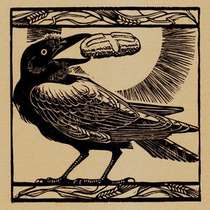
One day this June, while leaving the Abbey church there after morning prayer, I saw buzz of activity around a newly installed statue of Benedict. Sculpted by Br. David Paul OSB, Benedict holds a book and quill and is surrounded by more books and manuscripts. A large raven or crow stands at the saint’s feet. Often thought of as a bad omen or a harbinger of death, the crow has a brighter side, and even has a place on the jubilee medal. In Christian lore it can symbolize Divine Providence, bringing food to saints who, for one reason or another , are spending time alone in deserted places. Elijah, for example. Or Benedict.
Most of what is known about Benedict is found in the second book of the Dialogues of Saint Gregory the Great. In it we read the story of how Benedict, who fed bread crumbs to a crow each day, asked her to take a loaf meant for him that was poisoned by a jealous local priest, and drop it somewhere where no one would find it. The crow hesitated and then obeyed. Upon her return, Benedict fed her as usual.
The story of Benedict and the statue remind me that Divine Providence is not only something bestowed on saints of history, nor is it merely pious legend. God’s care comes to us in countless ways. Sometimes through people who fill our days. Family and friends, prayerful communities and maybe a sales associate at the department store offer concern, hope, and good cheer. Opportunities arise. Formative ideas are found in words written or spoken, in books or movies, in a card or letter. Or email.
 God is Present as always. We may not need rescued from a poisoned loaf, but we can all use support and nurture as we make our way through life. As Thomas Worcester reminds us, we are expected to offer the same support to others.
This blog post is a “thank you” to my Benedictine friends and the many others who bring God’s grace into my life. It is a challenge to bring Benedict’s commitment to the care and the common good to others. It is also an invitation to hope. Next time you hear a crow’s raspy caw or see the black birds roosting in a tree, remember that God sends sustenance through unlikely messengers.
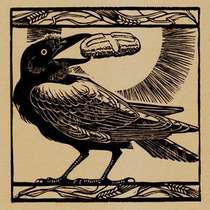
(Woodcut by Alison Wallace)
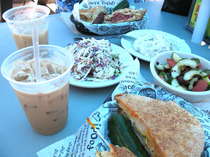
 Zingerman’s Bakery OK. I live in Columbus, Ohio not far from The Ohio State University. A Buckeye alumna, I may be expected by some to be less effusive about that “place up North,” but I must confess, I love Ann Arbor. I spent a couple of days there recently and enjoyed everything from the weather (7 to 10 degrees cooler than home) to the interesting shops and the plethora of ethnic eating places. Of course, the biggest draw is family, especially my daughter. Spending time exploring Ann Arbor is always most enjoyable with her.
 The next day, we added a stop at Panera’s, curry dinner prepared by my sister, and finally before I left, an amazing lunch at foodies world famous Zingerman’s Delicatessen. I added an after lunch splurge of dark chocolate covered marzipan and a turtle on my way to the freeway.
 What a glorious conglomeration. “An embarrassment of riches,” I said to my daughter, still playing with terms of venery started on the evening of
  PHOTO: Mary van Balen With all its faults, I am still grateful that I live in this country, my daughter said as we shared breakfast. I mean, when I wake up I might wonder how hot it is, or what I should wear when I go outside. I dont wonder if, once I venture outside my house, if I will return safely. Or return at all. Literally.
 PHOTO: Lisa Durkee According to James Liptons book
  PHOTO:Mary van Balen – Collegeville Institute early morning Noon prayer did it. Three funerals in the Abbey Church that day, so I successfully navigated the maze beneath it and found the small chapel where prayers would be said. Two psalms spoke: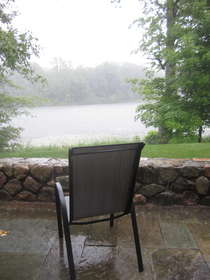
 PHOTO:Mary van Balen I stand on the patio behind the apartment and watch rain pour down in long lines, like strokes from a pen, shrouding everything in gray. Thunder rumbles in the background. A small chickadee, sinichka my friend from St. Petersburg called them, takes shelter in the blue spruce beside me. We are both hushed into reverential silence. I stand close to the brick house, beneath the overhang. Together, sinichka and I feel the wind and watch it play across the water, patches of light blooming and then, just as quickly, dissoloving back into dark as the wind changes its mind and churns up brightness somewhere else on the lake. Sometimes the light races across the surface, hanging on to the wind, but can’t keep up and lets go, falling back into smooth green water.
 I am standing here, trying to be wide. I don’t want my hair and clothes to be drenched, so I press close to the wall but push my soul out into the storm. “Come, Lord Jesus, Come,” I pray like it is Advent.
  PHOTO:Mary van Balen The Lord’s voice shattering the cedars;
 PHOTO: Mary van Balen – View from my apartment Apartment 7 has a new couch and chairs, new beds, but the same wall of windows overlooking the lake. From the moment the door opened up, I felt at home. This was the same apartment I lived in a few years ago while a resident scholar at the Collegeville Institute. I am honored to have been invited back for a weeklong writing workshop on spiritual autobiographical memoir directed by Lauren Winner.(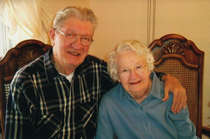
 PHOTO: Mary van Balen On Father’s Day I was winging my way to Collegeville, MN to participate in a weeklong writing workshop with Lauren Winner. My father was winging right along with me, I know. And how appropriate: Father’s Day. I can’t imagine a better father. Right up to his last days he was encouraging, giving hugs, and bestowing his warm smile. Love sparkled out of his blue eyes. Everyone at the nursing home loved dad. “A real gentleman.” “Such a sweet man.” “He waved at us when he was wheeled into the dining room.”
 Rublev’s “Trinity” © 2012 Mary van Balen